


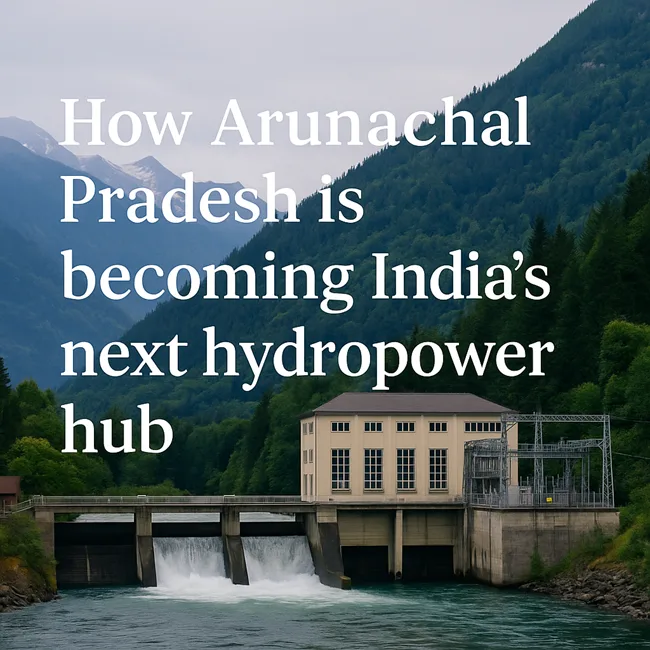
The approval of the ₹8,146.21 crore Tato-II Hydro Electric Project in Shi Yomi district marks another milestone in Arunachal Pradesh’s emergence as a cornerstone of India’s hydropower strategy. With an installed capacity of 700 megawatts (MW) and the ability to generate 2,738.06 million units (MU) annually, the project is more than just an infrastructure undertaking — it’s a signal that the Northeast is stepping into a larger role in the country’s energy transition.
Arunachal Pradesh, with its mountainous terrain and fast-flowing rivers, holds an estimated hydropower potential of over 50 gigawatts (GW). Yet, much of this capacity remains untapped due to logistical, environmental, and financing hurdles. Recent central approvals and joint venture structures, such as the one between North Eastern Electric Power Corporation Limited (NEEPCO) and the state government for Tato-II, show that the momentum is shifting toward accelerating development.
What other sanctioned and under-construction hydropower projects are shaping Arunachal Pradesh’s energy future?
Tato-II joins a growing list of sanctioned or ongoing projects that are reshaping the state’s energy landscape. Among the largest is the 2,880 MW Dibang Multipurpose Project in the Lower Dibang Valley, approved with a central investment exceeding ₹31,000 crore and designed to be India’s largest hydropower plant upon completion. The 2,000 MW Subansiri Lower Hydro Electric Project, straddling the border of Assam and Arunachal Pradesh, is also moving forward after years of delay, with commissioning targeted for the latter part of this decade.
Medium-sized developments such as the 600 MW Kameng Hydro Electric Project, now operational, and the 1,000 MW Siang Stage-II project, currently in the planning pipeline, indicate that the state’s hydropower build-out is not limited to mega-projects. Smaller run-of-the-river facilities are also under consideration to supply local demand and integrate more quickly into the grid.
The combination of large-scale and mid-sized projects is helping diversify Arunachal Pradesh’s energy portfolio while reducing reliance on any single development. This spread also mitigates some of the environmental and social risks associated with mega-dams by balancing them with smaller, lower-impact assets.
Central funding patterns are evolving to accelerate these projects. Beyond direct investment approvals, the Government of India is extending budgetary support for enabling infrastructure such as roads, bridges, and transmission lines. In the case of Tato-II, ₹458.79 crore has been earmarked for connectivity works alone, alongside ₹436.13 crore as central financial assistance toward the state’s equity share. These funding structures are critical in making remote projects financially viable for both developers and the state.
Institutional sentiment suggests that such blended funding models could become the norm for hydropower in challenging geographies. By sharing the upfront risk between central agencies, state governments, and public sector developers like NEEPCO, the financial barriers that have slowed progress for decades may finally be breaking down.
For Arunachal Pradesh, these developments are not just about energy supply; they’re also about long-term economic transformation. Large-scale hydropower brings investment into sectors like construction, logistics, and services, creating a multiplier effect across the local economy. The roads and bridges built for projects like Tato-II will outlast the construction period, improving access to healthcare, education, and markets.
However, grid integration remains a significant challenge. Much of Arunachal Pradesh’s hydropower capacity will be destined for consumption in other parts of India, requiring robust inter-state transmission infrastructure. The Power Grid Corporation of India Limited (PGCIL) and other agencies are investing heavily in high-capacity transmission lines to connect the Northeast with demand centres in the east, north, and west of the country. Without timely transmission upgrades, the risk of stranded generation assets could undermine the state’s potential.
Analysts tracking the sector point out that the next decade will be decisive. With climate change increasing hydrological unpredictability, adaptive water management will be critical to ensuring the long-term performance of these projects. There is also the need to align hydropower development with environmental safeguards and community engagement to avoid the delays and disputes that have historically slowed projects like Subansiri Lower.
If these challenges are addressed head-on, Arunachal Pradesh could transform from a relatively underdeveloped energy producer to a key clean power exporter within the national grid. This shift would not only strengthen India’s renewable energy share but also provide the state with a sustained revenue stream from surplus power sales.
The Tato-II approval illustrates a broader trend: hydropower in Arunachal Pradesh is no longer an abstract potential waiting to be tapped. With projects moving from planning to execution, funding mechanisms becoming more sophisticated, and grid infrastructure slowly catching up, the state is positioned to become India’s next hydropower hub.
For policymakers and investors alike, the lesson is clear — the key to unlocking Arunachal Pradesh’s 50 GW potential lies in pairing large-scale energy generation with equally large-scale investments in connectivity and community development. Done right, this could be the Northeast’s most significant contribution yet to India’s low-carbon future.
Discover more from Business-News-Today.com
Subscribe to get the latest posts sent to your email.