



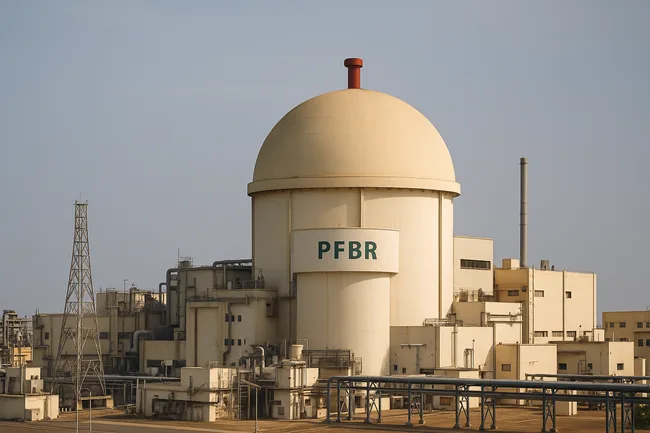
India is approaching a pivotal milestone in its nuclear power journey. The Prototype Fast Breeder Reactor (PFBR), a 500 MWe sodium-cooled reactor at Kalpakkam in Tamil Nadu, is now in the advanced stages of integrated commissioning, with first criticality targeted between 2025 and 2026. Once operational, the PFBR will mark India’s entry into the second stage of its three-stage nuclear programme, enabling the conversion of spent heavy water reactor fuel into plutonium and uranium-233, paving the way for thorium-based energy.
Why is the PFBR central to India’s long-term energy strategy?
India’s three-stage nuclear programme, conceived by Homi Bhabha in the 1950s, was designed to overcome the country’s limited uranium reserves by gradually moving from uranium-fuelled reactors (Stage 1) to fast breeder reactors (Stage 2), and ultimately to thorium-fuelled systems (Stage 3). With nearly a quarter to a third of the world’s known thorium reserves, India has a unique opportunity to secure energy independence through thorium-based nuclear power. The PFBR is the critical link in this chain, producing the fissile material needed for the third stage.
The sodium-cooled PFBR is designed to generate more fissile material than it consumes, closing the fuel cycle and reducing dependency on imported uranium. Beyond energy security, this approach supports India’s carbon reduction commitments by adding large-scale, low-carbon baseload power capacity.
Can PFBR still meet its revised commissioning timeline?
The reactor has already entered core loading and obtained regulatory clearance for criticality testing. Union Minister Jitendra Singh has confirmed that delays are due to first-of-a-kind technological issues typical of such pioneering projects. These include resolving commissioning-phase integration challenges and validating performance of safety systems. While these are being addressed systematically, they have shifted the operational start from earlier projections to a commissioning window that extends into late 2026.
If the remaining technical issues are resolved without major setbacks, PFBR could still achieve criticality within the revised timeframe. This would be a significant morale boost for India’s nuclear establishment, which has faced past criticism over extended project delays and cost escalations.
How will PFBR success shape the future of fast breeder deployment in India?
A successful PFBR will clear the way for India’s next generation of commercial fast breeder reactors, starting with the FBR-600 design. These 600 MWe units, planned for construction alongside PFBR at Kalpakkam, will benefit from lessons learned during PFBR’s commissioning. Multiple-unit deployment at a single site could reduce costs, simplify logistics, and strengthen domestic manufacturing capability.
India’s nuclear expansion plans already envision a capacity increase to 22.48 GW by 2031–32, combining pressurised heavy water reactors, light water reactors, and breeder technology. Looking further ahead, the government’s “Vision 2047” targets 100 GW of nuclear capacity, with breeders and thorium reactors as core contributors alongside small modular reactors.
What challenges must India overcome for breeder and thorium success?
While PFBR is technologically ambitious, its challenges are equally complex. First, sodium coolant systems demand exacting engineering and operational discipline, as sodium reacts violently with water and air. This requires stringent safety protocols and high-precision manufacturing of heat exchangers and piping.
Second, establishing a sustained plutonium fuel supply will be essential. This involves reprocessing spent fuel from the country’s existing heavy water reactors, a process requiring robust safeguards, regulatory compliance, and political will. The eventual move to thorium will need significant R&D investment to bring the Advanced Heavy Water Reactor (AHWR) design from concept to reality.
Finally, India’s strict regulatory framework for thorium mining—allowing only government or government-owned entities to extract and process thorium-bearing minerals—means that fuel supply will remain under public-sector control. This limits private sector participation but also ensures that strategic resources remain safeguarded.
Why PFBR matters beyond energy
From a strategic standpoint, PFBR is more than just a power project. It is a proof-of-concept for India’s ability to design, construct, and operate advanced nuclear technology indigenously. It reinforces India’s status as one of the few nations pursuing a closed nuclear fuel cycle and developing reactors tailored to its own resource base.
Internationally, success with PFBR could bolster India’s position in nuclear technology partnerships, enabling it to export components or collaborate on breeder reactor projects with countries seeking similar solutions to fuel constraints.
Domestically, the project’s eventual success could also shift public perception. While nuclear energy in India often faces opposition over safety concerns and cost, PFBR offers a narrative of resource efficiency, energy security, and climate-friendly generation that aligns with the country’s developmental and environmental goals.
Discover more from Business-News-Today.com
Subscribe to get the latest posts sent to your email.