


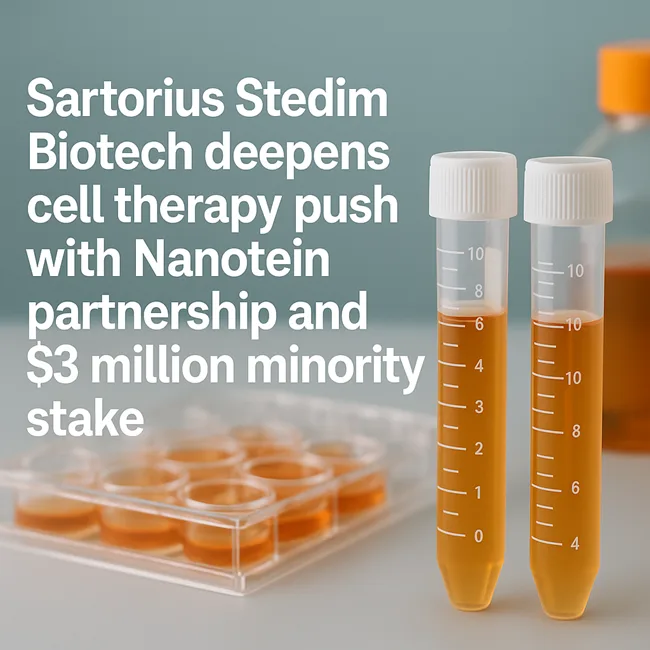
Sartorius Stedim Biotech S.A. (Euronext Paris: DIM) has entered a strategic partnership with Nanotein Technologies, combining an exclusive global distribution agreement for NanoSpark immune-cell activation reagents with an equity investment of up to US$3 million. The Aubagne-based bioprocess specialist said the alliance aims to speed immune-cell expansion and improve yield consistency for advanced therapies, while positioning Sartorius Stedim Biotech to broaden its consumables footprint in cell and gene therapy manufacturing. The deal gives Sartorius Stedim Biotech rights to distribute Nanotein’s NanoSpark STEM-T Soluble T Cell Activator and NanoSpark GROW-NK Soluble Activator worldwide, with research-use-only formats already available and current good manufacturing practice (cGMP) grades scheduled to follow in late 2025 for STEM-T and 2026 for GROW-NK.
How does the Sartorius Stedim Biotech–Nanotein agreement change immune-cell activation and why could feeder-free, soluble tools matter for CAR-T and NK programs across clinical manufacturing?
Under the exclusive distribution arrangement, Sartorius Stedim Biotech will place Nanotein’s lead activation reagents into its global channel, targeting developers that need scalable, reproducible expansion of T cells and natural killer cells for programs ranging from chimeric antigen receptor-T (CAR-T) to emerging NK therapies. Nanotein’s NanoSpark platform is designed as a fully soluble protein scaffold that presents functional antibodies via high-affinity, non-covalent interactions in geometries tuned for receptor clustering, an approach intended to stimulate robust ex vivo activation while improving the quality and phenotype of expanded cells. By design, the reagents aim to reduce dependence on feeder cells and to lift batch-to-batch consistency, two recurrent bottlenecks in autologous and allogeneic workflows.
What makes NanoSpark a differentiated activation technology and what practical gains do developers get in yield, phenotype control, and downstream manufacturability at scale?
Technical descriptions from the manufacturer indicate that NanoSpark activators can be sterile-filtered and washed out through standard media exchange, streamlining closed-system processing and reducing downstream clean-up complexity. Product literature also describes control over CD4:CD8 ratios during expansion and maintenance of stem-like phenotypes such as Tscm, attributes that are often linked in the literature to persistence and potency in adoptive cell therapies. In practice, those features point to higher viable cell yields, more predictable starting material for gene delivery, and smoother release testing, which in turn can compress vein-to-vein timelines and lower cost of goods. While developers will ultimately validate those gains in their own runs, the soluble, feeder-free profile directly targets well-known pain points in both R&D and cGMP settings.
How does the transaction fit Sartorius Stedim Biotech’s growth thesis in consumables and what do current half-year results suggest about investor expectations for the broader portfolio?
Sartorius Stedim Biotech has emphasized recurring, high-margin consumables as its growth engine, and recent half-year results underscore that tilt. For the first half of 2025, sales revenue reached €1,489.6 million, up 9.4 percent in constant currencies, led by strength in single-use consumables, while underlying EBITDA rose 19.3 percent to €461.9 million, expanding margin to 31.0 percent. Management reiterated full-year guidance for about 7 percent organic revenue growth and a 30–31 percent underlying EBITDA margin. For investors, those figures reinforce a story of mix shift toward consumables and platform adjacencies—precisely the category where NanoSpark would sit once cGMP grades are commercialized, potentially adding a differentiated tool to Sartorius Stedim Biotech’s cell and gene therapy catalogue.
When will cGMP-grade NanoSpark formats be available globally and what does the timeline imply for clinical adoption, validation cycles, and supply readiness across 2025–2026?
Nanotein and Sartorius Stedim Biotech indicate that research-use-only variants of STEM-T and GROW-NK are already on the market, with cGMP-grade STEM-T targeted for late 2025 and cGMP-grade GROW-NK expected in 2026. That sequencing suggests near-term evaluation in tech-transfer and process-development settings, followed by formal qualification and comparability runs as cGMP material comes online. For clinical programs, the 2025–2026 window creates a realistic path to integrate the reagents into Phase I/II manufacturing, provided internal process changes pass quality and regulatory review. Notably, Nanotein has separately engaged Akron Bio for cGMP production of STEM-T, a step that speaks to supply chain build-out ahead of clinical use.
How large is the strategic aperture for Sartorius Stedim Biotech in cell and gene therapy tools, and what signal does a US$3 million minority stake send about optionality across future joint development?
While the minority investment is modest in absolute terms, the signal value is meaningful: Sartorius Stedim Biotech gains early access to a platform-level reagent technology with joint-development rights that could seed additional products for T-cell and NK-cell workflows. The partner has a track record of expanding its portfolio through complementary technologies, and its published profile points to an organization built to integrate niche innovations that improve manufacturing speed, safety, and sustainability. In an environment where developers want fewer vendors and more integrated solutions, a distribution-plus-development model allows Sartorius Stedim Biotech to test product-market fit quickly and scale winners through its established global sales and service infrastructure.
What are analysts and institutional investors likely to focus on next, and how does current stock performance frame sentiment around execution, margins, and end-market demand?
Institutional investors are likely to read the Nanotein partnership as consistent with Sartorius Stedim Biotech’s consumables-led strategy, and will probably look for evidence of early adoption in pilot sites, order momentum as cGMP supply goes live, and any margin lift attributable to mix. As a listed security on Euronext Paris under the ticker DIM, Sartorius Stedim Biotech has recently traded in a consolidating range. On headlines around late July and into August, third-party quote services showed intraday levels in the high-€160s to low-€170s, with session gains on some days but a still-negative year-to-date change. While precise real-time figures vary across feeds, the directional picture supports a cautious-constructive stance: investors see improving profitability and guidance confidence, but remain sensitive to capital-spending hesitation among end customers and the pace of normalization across equipment and systems.
How does Sartorius Stedim Biotech’s listing details, index inclusion, and shareholder structure reinforce its visibility with global investors during the cell therapy tools expansion?
Corporate investor materials confirm that Sartorius Stedim Biotech’s ordinary shares are listed on Euronext Paris with ISIN FR0013154002 and ticker DIM, included across major French and European indices such as SBF 120, CAC Next 20, and STOXX Europe 600. The group reports approximately 97.3 million shares outstanding, with Sartorius AG holding a controlling stake and a free float near 28.5 percent. That capitalization profile, combined with dedicated healthcare index inclusion, helps maintain liquidity and visibility with generalist funds who may be tracking profitability recovery and consumables growth.
What is the practical impact for therapy developers in the next 12 months, and which operational milestones should readers watch to judge whether this partnership is delivering manufacturing value?
Over the next year, the most tangible markers will be developer-reported gains in expansion kinetics and phenotype control during tech-eval runs; movement from RUO to cGMP-qualified lots; and any case studies that link NanoSpark use to improved batch success rates or shorter expansion windows. Readers should watch for customer presentations referencing feeder-free NK expansion, comparability assessments when switching activators, and any updates from Sartorius Stedim Biotech tying the reagents to its single-use bioprocess footprint. Given that Sartorius Stedim Biotech has reiterated its 2025 guidance on the back of strong consumables demand, even modest incremental contribution from new activation tools could help sustain margin resilience as the broader equipment cycle normalizes.
Does this distribution-plus-equity model materially advance Sartorius Stedim Biotech’s competitive edge in the cell therapy tools market over the medium term?
In my assessment, the partnership is strategically sound and appropriately sized for optionality. The exclusive global channel gives Nanotein rapid reach, while the minority stake aligns incentives without overcommitting capital. The technology’s soluble, feeder-free profile is on trend with the industry’s push toward closed, modular, and predictable manufacturing. If cGMP timelines hold and early adopters validate phenotype and yield claims at scale, Sartorius Stedim Biotech can credibly layer NanoSpark into an integrated consumables story that already benefits from recurring revenue and margin accretion. Execution risks remain—chiefly, demonstrating clear superiority over existing activation systems in head-to-head runs and ensuring supply continuity—but the risk-reward looks favorable against the company’s current portfolio mix and guidance posture.
Share this:
Discover more from Business-News-Today.com
Subscribe to get the latest posts sent to your email.