




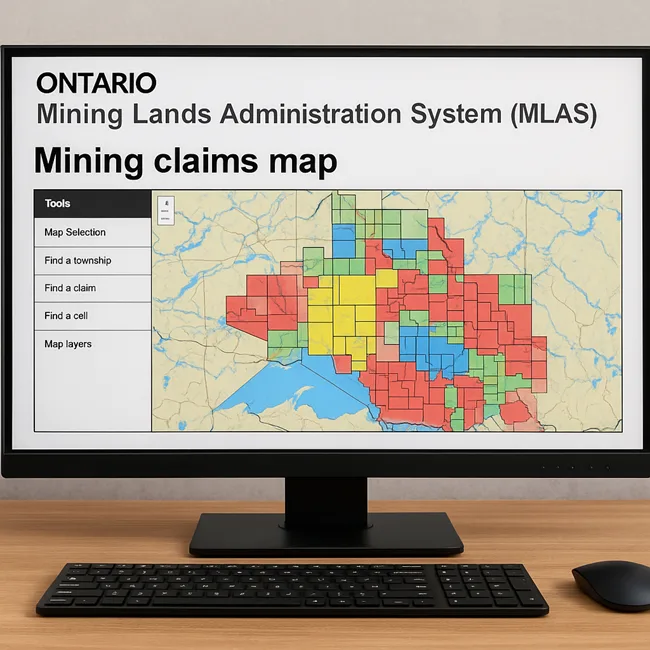
How Ontario’s mining land registry is enabling a wave of strategic acquisitions by junior explorers
Ontario’s Mining Lands Administration System (MLAS) has emerged as one of the most efficient and transparent mineral rights management frameworks in Canada, attracting growing interest from both domestic junior explorers and international mining companies in 2025. The recent announcement by Barranco Gold Mining Corp. (CSE: BAR, FWB: 314) that it is in final negotiations to acquire a package of Ontario mineral claims highlights the platform’s central role in facilitating high-value exploration transactions.
Administered by the Ontario Ministry of Mines, MLAS offers a fully digital interface for staking, transferring, and managing mineral claims. This shift from traditional paper-based systems to an online registry has significantly lowered the entry barrier for exploration companies, allowing them to monitor land availability in real time and act quickly when strategic opportunities arise. For small-cap explorers with limited staff and tight capital budgets, this efficiency is proving to be a critical competitive advantage.
Why are explorers turning to MLAS for land acquisition strategies in 2025?
One of the MLAS system’s key advantages is its ability to provide up-to-date geological and tenure data at the click of a button. For companies like Barranco Gold Mining Corp., the ability to evaluate claim status alongside regional exploration history enables rapid decision-making. In the past, acquiring mineral claims often involved lengthy manual reviews, on-the-ground inspections, and extended government processing times. Today, much of this work can be completed remotely within hours.
This speed is especially valuable in competitive exploration corridors where adjacent land to producing or advanced-stage mines can be staked or acquired almost immediately after becoming available. The system’s transparency also enhances investor confidence, as shareholders can independently verify claim status and location—reducing the risk of misinformation or disputes over land ownership.
How does MLAS fit into Ontario’s broader mining strategy and investor appeal?
Ontario is a global mining jurisdiction with a long history of producing gold, nickel, copper, and other critical minerals. The province has actively positioned itself as a hub for resource investment, not just by promoting its geological potential but also by streamlining the administrative side of mining. MLAS is part of that modernization push, and it complements other investor-friendly measures such as competitive royalty structures, well-developed infrastructure, and strong legal frameworks.
For institutional investors evaluating junior mining equities, the presence of an efficient land administration system can significantly influence jurisdictional preference. Asset security and regulatory clarity are top priorities, especially in early-stage investments where much of the company’s value is tied to exploration rights rather than proven reserves.
What role could MLAS play in accelerating exploration and M&A activity?
Analysts tracking the Canadian mining sector believe MLAS could indirectly accelerate mergers and acquisitions among junior explorers. The ability to quickly identify and secure claim packages means companies can build contiguous land positions more easily, making them more attractive to larger producers looking for bolt-on opportunities. For example, Barranco’s move to acquire claims adjacent to two active mining projects would have been more complex under a slower, manual claims process.
There’s also the potential for MLAS to support the rise of “data-driven staking,” where AI and geospatial analytics are used to scan public geological databases and identify optimal claim targets. This approach is gaining momentum in North America, and Ontario’s fully digital system could be an early beneficiary.
What are the limitations and risks of relying on a digital claims system?
While MLAS offers clear advantages, it is not without limitations. High-speed digital access means competition is fierce—prime ground can be claimed within minutes of becoming available. For smaller companies, this requires continuous monitoring and quick mobilization of capital for staking fees and potential acquisitions.
Furthermore, acquiring land through MLAS is only the first step. Successful exploration still depends on sound geological targeting, effective community engagement, and regulatory compliance. Overreliance on the ease of land acquisition without adequate technical follow-through can lead to underperforming projects.
Still, the system’s efficiency and transparency are strong selling points for Ontario as a mining destination. For explorers like Barranco Gold Mining Corp., MLAS is more than a registry—it’s a strategic enabler that could shape the pace and direction of their growth.
Discover more from Business-News-Today.com
Subscribe to get the latest posts sent to your email.


