




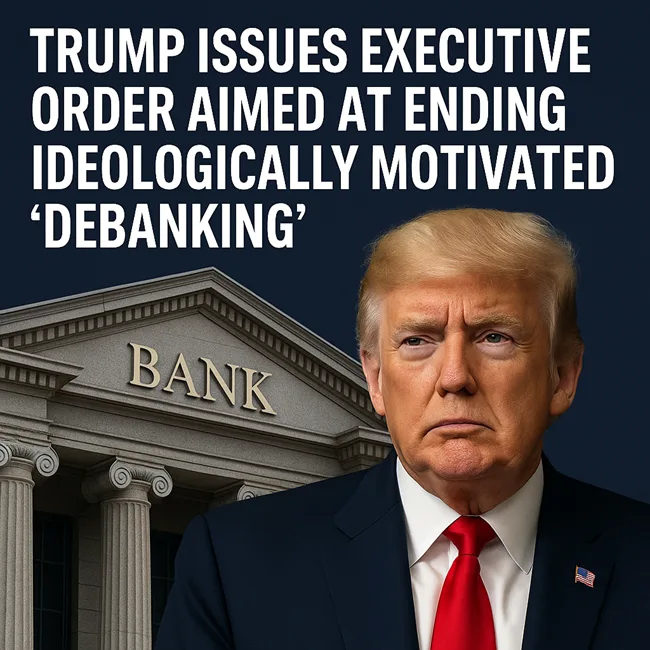
President Donald Trump signed an executive order on August 7, 2025, directing U.S. banking regulators to eliminate policies and guidance that allow financial institutions to deny services based on a customer’s political or religious beliefs or lawful business activities. Titled “Guaranteeing Fair Banking for All Americans”, the order sets in motion an overhaul of risk-assessment rules in the banking sector, compelling agencies to remove “reputational risk” as a factor in supervisory decisions.
The White House says the measure is designed to ensure “equal access to financial services” and to prevent what critics label as “politicised debanking.” The move aligns with Trump’s campaign promise to counter alleged ideological bias in large financial institutions, while triggering debate over whether such restrictions could undermine fraud prevention and anti-money-laundering safeguards.
What historical context and precedents led to the “debanking” executive order’s introduction?
The executive order builds on years of political contention around account closures that advocacy groups on both the left and right say have targeted lawful businesses. Under the Obama administration, initiatives like Operation Choke Point sought to discourage banks from working with certain high-risk industries, such as payday lending or firearms sales. While officially ended in 2017, industry groups argue that informal “reputational risk” assessments persisted, sometimes affecting politically sensitive sectors including energy, cannabis, and firearms manufacturing.
President Trump has repeatedly claimed that his own companies, as well as conservative advocacy groups, have been denied accounts or services for political reasons. Major U.S. banks such as JPMorgan Chase and Bank of America have denied those allegations, asserting that closures are based on regulatory compliance or illicit-activity concerns rather than ideology.
By formally removing “reputational risk” from examination manuals and guidance documents, the new directive moves beyond piecemeal policy changes, embedding the shift into federal rulemaking and compliance frameworks.
What specific mandates and compliance deadlines does the executive order impose on U.S. financial regulators?
The order outlines several key mandates with strict implementation timelines. Financial regulators—including the Federal Reserve, Office of the Comptroller of the Currency (OCC), and Federal Deposit Insurance Corporation (FDIC)—must eliminate “reputational risk” as a regulatory concept within 180 days. Supervisory manuals, guidance documents, and examiner training materials must be updated to ensure risk-based evaluations focus strictly on legal compliance and financial soundness.
The Small Business Administration (SBA) is required to notify its network of lenders about the new requirements within 120 days and to reinstate access for clients who may have been denied services for political or religious reasons. The Treasury Department, working with the White House economic policy team, must produce a detailed strategy within 120 days to address politically motivated debanking and to implement a uniform appeals process for customers whose accounts are closed.
Regulators are also instructed to review account closures from prior years, identify cases potentially linked to political or religious bias, and refer unlawful instances to the Department of Justice.
How has the banking industry and regulatory leadership responded to the new directive?
Initial reactions from regulatory leadership suggest strong alignment with the order’s objectives. The FDIC stated that denying banking services to lawful businesses or individuals based solely on ideology is “unacceptable” and committed to integrating the order’s principles into upcoming rulemaking. Industry trade associations have generally welcomed the removal of subjective reputational standards, arguing that it will bring greater clarity and predictability to compliance.
However, privately, some senior banking executives have expressed concern that removing reputational considerations could expose institutions to higher operational and legal risks. They note that the banking sector is already under pressure to detect and prevent illicit activity, with global compliance costs expected to exceed USD 50 billion annually through 2026. Stripping out subjective but preventive tools, they argue, could increase vulnerability to fraud and financial crime.
What is the institutional and analyst sentiment on potential risks and benefits of the order?
Institutional investors and market analysts appear divided. Supporters highlight the potential for the order to reduce regulatory overreach and prevent arbitrary account terminations that could harm brand loyalty and customer trust. They note that for sectors historically affected by debanking—such as energy, agriculture, and certain manufacturing segments—the directive may improve access to credit and payment processing, potentially boosting operational stability.
Cautious voices, however, warn that the executive order could inadvertently tie the hands of banks in cases involving extremist or high-risk clients. They emphasise that without robust definitions of “lawful business activity” and clear carve-outs for anti-money-laundering and counter-terrorism efforts, institutions could face lawsuits for account closures that are otherwise aligned with safety and soundness obligations.
What data points highlight the stakes for compliance and financial crime prevention?
The compliance challenge is underscored by recent financial crime trends. In 2024, U.S. consumers reported nearly USD 13 billion in fraud losses, up more than 25 percent from the prior year. The Federal Trade Commission has warned that identity theft and payment-platform fraud are growing at double-digit rates annually. Globally, regulatory bodies expect that anti-money-laundering frameworks will need to handle increased transaction monitoring volumes as payment digitisation accelerates.
Removing “reputational risk” from decision-making could force banks to rely entirely on legal and financial metrics, reducing their ability to pre-emptively manage brand exposure and customer trust. This tension between access and risk control will be central to how the order is implemented.
What legislative moves are emerging to reinforce or expand the executive order’s provisions?
The order has already inspired parallel legislative activity. Representative Andy Barr has introduced a bill in the U.S. House of Representatives that would codify the removal of reputational risk from regulatory language and make objective, risk-based banking standards a matter of law. Similar proposals, such as the proposed Fair Access to Banking Act, are circulating in the Senate, aiming to provide permanent legislative backing that would survive changes in administration.
If passed, such legislation would make it significantly harder for future administrations to reintroduce reputational risk criteria, locking in the current shift toward strictly objective risk-based assessments.
What is the potential long-term impact on banks, customers, and financial regulation?
If implemented with precision, the executive order could broaden access to financial services for individuals and industries that have historically faced difficulties obtaining banking relationships due to perceived ideological stigma. This may encourage new entrants into sensitive sectors such as firearms retail, fossil fuel extraction, or politically aligned media, knowing they have greater protection against arbitrary account termination.
At the same time, banks must navigate the compliance burden of documenting every closure to ensure it meets legal and financial risk thresholds. The Treasury’s forthcoming strategy is expected to recommend a national appeals framework, which could give customers recourse if they believe closures are ideologically motivated. Analysts believe that transparent closure policies and clear communication could help mitigate reputational fallout for institutions while preserving operational security.
How could Trump’s “debanking” executive order reshape the long-term balance between financial access and banking security?
President Trump’s executive order on debanking represents one of the most significant regulatory shifts in U.S. banking policy in recent years. Its success will depend on how effectively regulators can balance the goals of fair access and financial crime prevention. For banks, this means adapting compliance processes without compromising safety. For customers, it could mean a new era of access—provided the safeguards are implemented as intended.
Discover more from Business-News-Today.com
Subscribe to get the latest posts sent to your email.

