



McDonald’s Corporation (NYSE: MCD), the world’s largest fast-food company, is taking a strategic step to reestablish its appeal among low-income consumers in the U.S., a demographic that has significantly cut back visits in recent quarters. During its second-quarter 2025 earnings call, CEO Chris Kempczinski acknowledged that $10 combo meals are deterring some of the company’s most loyal domestic customers. In response, McDonald’s is rolling out a value-oriented strategy focused on simpler pricing, revamped menu boards, and affordable bundles to recapture price-sensitive diners.
Despite strong international growth and better-than-expected financial results, McDonald’s has found itself in a difficult position at home. As inflation continues to squeeze household budgets, low-income Americans—traditionally a core base for the brand—are choosing alternatives or skipping out altogether. According to management, traffic from this group dropped by double digits year-over-year. The new plan aims to reverse that decline by sharpening the company’s value proposition and improving how affordable options are displayed, particularly on digital menu boards.
What changes is McDonald’s making to pricing and drive-thru menu boards to restore value perception?
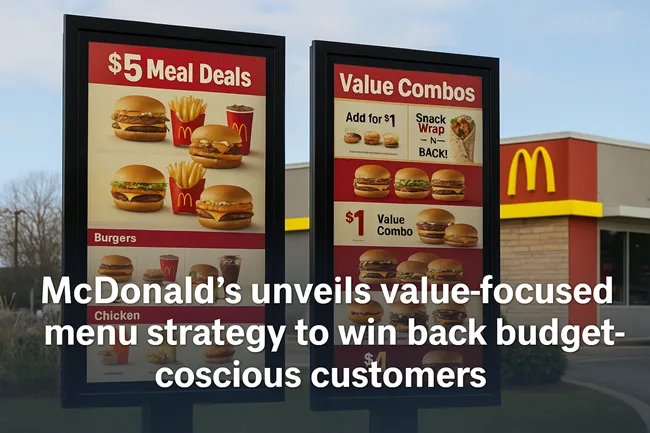
At the heart of McDonald’s recovery plan is a renewed push to make value visible—literally—through revamped drive-thru and in-store digital menu boards. Executives emphasized during the earnings call that affordability is often a matter of perception, and the layout and structure of menu boards can heavily influence customer behavior.
To support this effort, the company has reintroduced $5 meal bundles, brought back the popular $2.99 Snack Wrap, and allowed consumers to customize small meal combinations with $1 add-ons. These offerings are not positioned as discounts, but rather as curated, price-conscious options designed to reassure customers they can eat at McDonald’s without breaking the bank.
Chris Kempczinski told investors that franchisee alignment was critical to delivering consistent value experiences across locations. The company is now working with operators to adjust local pricing, highlight smaller portion combos, and standardize the way value meals are communicated. This includes updating digital signage to prioritize low-cost items and reduce decision fatigue during ordering—particularly at high-traffic drive-thru lanes.
This strategy reflects McDonald’s longstanding reliance on value as a competitive differentiator. However, in recent years, inconsistent pricing and localized menu board designs have muddled that messaging. Executives are betting that simplifying the interface—and the pricing—can begin to rebuild trust among price-sensitive segments.
How is McDonald’s tackling the drop in visits from low-income diners while middle-income traffic improves?
While McDonald’s has successfully restored footfall from middle-income households through targeted deals and promotions, the situation among low-income Americans is more severe. The company reported a steep double-digit decline in this group’s traffic—a troubling sign for a brand that once thrived on affordability and accessibility.
Analysts point to persistent inflation, rising food costs, and shifting perceptions about fast food value as key contributors to this decline. Some consumers now see fast food chains as relatively expensive, with $10+ combo meals undermining the idea of McDonald’s as a cheap, convenient option. Competitors like Wendy’s and Taco Bell have leaned heavily into budget menus, further intensifying the competitive landscape.
Kempczinski emphasized that “value doesn’t mean discounting,” but instead means giving customers enough flexibility to build meals within their price point. This includes more granular price tiers, smaller portion choices, and clearer bundling logic. For McDonald’s, success will hinge on striking a balance between customer satisfaction and margin protection—especially as franchisees face cost pressures on labor, beef, and packaging.
Institutional investors have taken note of this strategic pivot, seeing it as a realistic attempt to reclaim a vulnerable market segment without triggering a race to the bottom on pricing.
How do McDonald’s international markets compare and what do Q2 results signal about financial strength?
Globally, McDonald’s delivered a strong performance in the second quarter of 2025, driven largely by international markets. Comparable sales rose 3.8% worldwide, exceeding Wall Street estimates, while the U.S. business posted a more modest 2.5% gain. The stock jumped nearly 3% following the earnings release and is up around 6% year-to-date.
European markets, led by France and Germany, reported strong sales growth fueled by localized promotions and digital app usage. Similarly, the company continues to gain traction in Japan, Australia, and Latin America, where menu affordability and digital loyalty programs have delivered measurable customer retention.
This global strength has given McDonald’s the financial flexibility to pilot new pricing models and promotional tactics in the U.S. without immediately impacting the bottom line. However, executives stressed that turning around U.S. traffic trends—especially among value-seeking customers—remains a critical priority for long-term investor confidence.
Analyst sentiment following the earnings call was generally positive, with many describing the value-first initiative as a “back-to-basics” move that aligns with McDonald’s historical brand identity.
What does consumer sentiment reveal about McDonald’s strategy to win back affordability-focused diners?
Consumer sentiment across digital platforms is mixed. On X (formerly Twitter) and Reddit, some users praised McDonald’s for bringing back low-priced favorites like the Snack Wrap, while others remained skeptical about the broader price landscape. “Still not worth it if I’m paying $12 for lunch,” wrote one user in a thread about fast food inflation.
Franchisees, meanwhile, have expressed cautious optimism. Some operators worry about thinner margins, but many see value bundles as necessary to regain customer traffic—especially in lower-income zip codes where QSR competition is intense.
Investor reactions were similarly measured. While analysts welcomed the proactive tone of McDonald’s messaging, some flagged execution risks around consistency and branding. Value menus can dilute brand perception if implemented unevenly, and smaller portion combos may frustrate customers expecting “more for less.”
Still, sentiment within the institutional community appears to lean optimistic. Many view this as a tactical reset rather than a sign of structural weakness. The key will be ensuring that the promised menu clarity and affordability translate into actual foot traffic and sustained customer loyalty.
Can McDonald’s balance affordability with profitability without damaging brand value?
As food costs rise and discretionary income shrinks, McDonald’s is attempting a difficult balancing act: remain affordable without sacrificing margins or diluting the brand’s premium positioning built around speed, consistency, and global presence.
Franchisee engagement will play a pivotal role in this effort. Operators control pricing in many U.S. markets, and aligning their incentives with the company’s national affordability push is vital. To succeed, McDonald’s must avoid the pitfalls of previous failed value menu campaigns, which at times created confusion or attracted only short-term deal-seekers.
Chris Kempczinski appears aware of this, repeatedly emphasizing that value does not mean permanent discounting. Rather, the new menu strategy aims to restore McDonald’s traditional positioning as a go-to brand for everyone—from families to students to working-class diners—while still protecting financial performance.
The return of the Snack Wrap, simplified combo pricing, and revamped digital menu boards are all pieces of that larger puzzle. If executed well, they may help restore McDonald’s reputation as a price-friendly choice in an increasingly competitive QSR market.
Discover more from Business-News-Today.com
Subscribe to get the latest posts sent to your email.