

Apple Inc. (NASDAQ: AAPL) has announced a sweeping new commitment to invest $100 billion in U.S.-based manufacturing and artificial intelligence research over the next four years, marking one of its largest domestic reinvestments in history. The move comes amid rising geopolitical tensions and the imposition of new tariffs on global trade, including the White House’s recent 50% duty hike on Indian imports. Apple’s decision is widely seen as a strategic hedge against escalating supply chain risks and a show of alignment with Washington’s industrial policy goals.
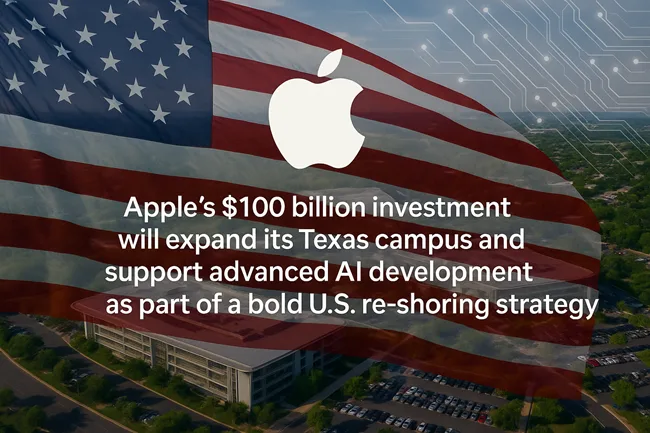
According to Reuters, this $100 billion pledge is in addition to the $500 billion Apple has previously committed toward U.S. production and research and development efforts. White House spokesperson Taylor Rogers praised the announcement, describing it as an action that “helps protect our economic and national security.” At the center of this new initiative are plans to dramatically expand Apple’s Texas manufacturing campus and scale up artificial intelligence innovation through new U.S.-based research centers.
Why is Apple investing $100 billion to bring manufacturing and AI research back to the United States?
Apple’s aggressive push into domestic production reflects a growing need to secure its operations against tariff volatility, pandemic disruptions, and geopolitical headwinds. Historically, Apple’s supply chain has been deeply rooted in Asia—particularly in China, Vietnam, and Taiwan—making it vulnerable to international conflicts and regulatory unpredictability.
The latest $100 billion investment signals a tectonic shift. Analysts argue that the re-shoring strategy is not only about mitigating trade war impacts but also about enabling faster integration of next-generation technologies such as advanced AI processors and AR/VR hardware. By building fabrication plants and R&D hubs closer to its California design centers, Apple can tighten feedback loops between engineering and manufacturing, improving time-to-market and quality control. Political motivations are also undeniable. The initiative comes at a time when Big Tech firms are under scrutiny in Washington over jobs, competition, and privacy. A domestic manufacturing surge provides Apple with leverage in ongoing regulatory negotiations.
What are Apple’s key U.S. projects under this initiative, including the Texas plant and AI centers?
At the heart of the investment lies Apple’s expansion of its Austin, Texas, manufacturing complex. The site, which currently handles Mac Pro assembly, is slated to become a full-scale production hub for a wider range of devices, including iPhones and next-generation augmented reality products. The new facilities are expected to create thousands of jobs and establish Apple as one of the largest tech employers in the region.
Beyond hardware, Apple is betting big on artificial intelligence. The company plans to open several AI and machine learning research centers across the U.S., with a focus on enhancing its ecosystem’s on-device intelligence. This includes more advanced versions of Siri, privacy-preserving AI algorithms, and features optimized for new Apple Silicon chips. Chief Executive Officer Tim Cook acknowledged that Apple has “significantly lagged” in generative AI compared to rivals such as Microsoft Corporation and Alphabet Inc. (Google), but emphasized that the new investment would allow Apple to catch up and possibly surpass competitors in user-focused innovation.
How does the move reflect Apple’s tariff mitigation and supply chain stabilization strategy?
The announcement comes as Apple confronts rising costs tied to import duties. According to internal estimates cited by Reuters, the company expects to absorb $1.1 billion in new tariff expenses this quarter alone. Last quarter, tariffs reportedly cost Apple $800 million. This pressure has already influenced consumer behavior, with a reported 13.5% spike in iPhone sales driven by fears of imminent price hikes.
However, this kind of pull-forward demand is not sustainable. By localizing more of its manufacturing, Apple hopes to insulate itself from the long-term unpredictability of U.S. trade policy. Additionally, the firm is diversifying its production footprint beyond China, ramping up operations in India and Vietnam. While these moves reduce single-market dependency, domestic manufacturing offers the ultimate tariff shield, giving Apple flexibility in pricing, logistics, and regulatory compliance.
What are the early signs of investor reaction and how might the investment affect Apple’s financial trajectory?
Apple’s stock jumped nearly 3% in after-hours trading following the announcement, signaling strong investor approval. Analysts viewed the $100 billion commitment as a confidence-building measure that aligns Apple more closely with U.S. policy goals, a factor that could reduce future antitrust pressure. Still, the stock remains down roughly 17% year-to-date in 2025, primarily due to uncertainty around tariffs and slow deployment of generative AI features.
The financial community remains split on the long-term implications. Some fear that the sheer scale of the investment will weigh heavily on Apple’s free cash flow. However, others point to the company’s continued strength in iPhone sales, service revenue, and solid gross margins—estimated at 46.5% in the fiscal third quarter—as evidence that the tech giant can absorb the cost while maintaining profitability. Apple’s earnings per share (EPS) of $1.57 beat analyst expectations, reinforcing the view that the company has sufficient financial headroom to fund long-term innovation while delivering shareholder value.
How is market sentiment shifting after Apple’s announcement, and what are the risks to watch?
Investor sentiment toward Apple appears to be turning cautiously optimistic. Morgan Stanley upgraded the stock to “overweight,” highlighting how the U.S.-based manufacturing pivot could insulate the company from trade risk while generating goodwill in domestic policy circles. Social sentiment is more polarized. On X (formerly Twitter), some users praised the move as “patriotic capitalism,” while others criticized it as a pretext for future product price hikes.
Institutional sentiment seems to coalesce around a central thesis: Apple’s $100 billion investment is a strategic repositioning for an AI-dominated future, but it carries execution risk. Industry experts warn that building out semiconductor fabrication plants and AI labs in the U.S. involves long timelines, complex permitting, and a highly competitive labor market. Apple will face off with players like Intel Corporation, Taiwan Semiconductor Manufacturing Company, and NVIDIA Corporation in the war for top AI and chip design talent.
Is Apple’s U.S. investment a smart hedge or a reactive move to political pressure?
In my professional view, Apple’s latest commitment is less about immediate returns and more about future-proofing the brand. With AI rapidly becoming the battleground for consumer technology differentiation, Apple cannot afford to remain a laggard. Building its AI and manufacturing muscle at home helps Apple reduce geopolitical exposure while positioning itself as an American innovator aligned with national priorities.
But while the $100 billion figure is headline-grabbing, the success of this initiative will rest on execution. Semiconductor production and AI research require years of sustained effort, a robust talent pipeline, and strategic focus. Apple has the financial resources, but must demonstrate organizational will. This decision reflects a larger industry pattern: the tech sector’s recalibration in favor of sovereign resilience, national security alignment, and supply chain robustness.
Ultimately, if Apple delivers on this investment without major operational setbacks, it could become the blueprint for how Big Tech survives—and thrives—in a fragmented global economy.
Share this:
Discover more from Business-News-Today.com
Subscribe to get the latest posts sent to your email.