


In 2025, the global wave of dam retrofitting is accelerating—but even the most well-funded projects are facing a quietly recurring issue: water leakage through joints that were either poorly sealed or never upgraded. Across India, Southeast Asia, the U.S., and parts of Europe, engineering teams have reported that despite structural reinforcements and instrumentation upgrades, gravity dams continue to suffer from chronic seepage. The common culprit? Inadequate joint sealing systems that fail under modern hydrostatic loads and thermal stress.
What are the main causes of leakage in concrete dam retrofits and how do joint sealing failures contribute?
While structural fatigue and outdated spillway capacity often dominate the retrofit agenda, the reality is that many dams fail at their seams—specifically, the joints between concrete blocks or lifts. In older gravity dams built before the 1980s, construction joints were often sealed using rigid PVC waterstops or grouted profiles. Over time, these materials degrade, harden, or separate due to joint movement, concrete shrinkage, or chemical attack from waterborne contaminants. The result is a clear seepage path along the joint line, which compromises both internal galleries and downstream faces.
Modern retrofits often make the mistake of reinforcing the structure while leaving outdated or degraded joint sealing systems in place. Because joint leakage may not immediately threaten structural integrity, it is sometimes deprioritized. But engineers warn that this short-term oversight leads to long-term costs: internal erosion, damp instrumentation tunnels, corrosion of steel reinforcement, freeze-thaw cracking in colder regions, and loss of stored water volume—all stemming from joints that were not properly resealed.
In addition, gravity dam retrofits must contend with irregular joint geometries caused by settlement or earlier patchwork maintenance. Traditional sealing products, like rigid PVC waterstops, require smooth, uniform concrete interfaces to bond effectively. When applied to aged or uneven surfaces, they fail to form a complete seal. Leakage may remain invisible for months or years, surfacing only during full reservoir conditions or seasonal changes, when pressure and temperature extremes widen gaps in the joint profile.
How are new joint sealing technologies solving the leakage problem in gravity dam rehabilitation?
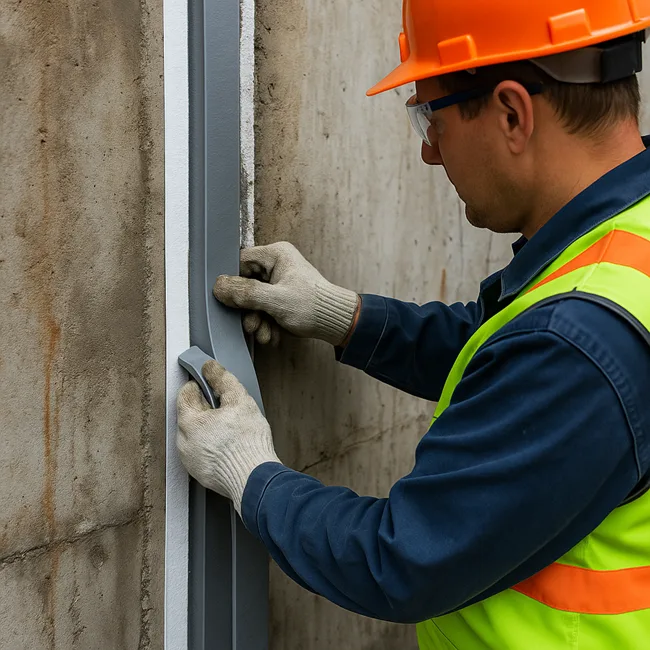
A new generation of sealing systems is now emerging to address the limitations of legacy waterstop technologies. Hydrophilic rubber strips, for example, expand in contact with water, actively sealing microcracks and voids in joint lines. When bonded with epoxy adhesives, these materials form a flexible barrier that adapts to thermal expansion, joint movement, and minor settlement—conditions that would compromise older rigid profiles.
More advanced systems include injectable polyurethane-based joint seals that conform to irregular geometries, as well as modular sealing profiles installed into pre-cut grooves or cavities. These are particularly useful in retrofit scenarios where access is limited and precision work is required inside inspection galleries or narrow lift joints. Their ease of installation and compatibility with aged concrete make them highly attractive to engineering contractors working under tight dam safety timelines.
Simulation-based tools are also improving how joint sealing is designed and executed. Modern dam rehabilitation plans now include finite element models that simulate joint behavior under variable reservoir pressures, thermal gradients, and seismic stress. These models help identify the locations most susceptible to leakage and recommend appropriate sealing strategies—before the contractor ever sets foot on site.
In major programs like India’s Dam Rehabilitation and Improvement Project (DRIP), joint sealing is increasingly being integrated into baseline technical specifications. Rather than treating leakage as a secondary concern, these programs now view watertight integrity as a performance indicator on par with energy generation or spillway safety. That shift in priority is reshaping procurement, design standards, and post-construction inspection protocols across public-sector hydro infrastructure.
What are the long-term risks of ignoring joint sealing during dam retrofits?
Engineers and dam operators are clear: retrofitting a dam without addressing its joint sealing is like installing new locks on a house with broken windows. Leakage not only undermines hydraulic performance but introduces hidden vulnerabilities. In some older dams, seepage into inspection galleries has damaged electrical systems and monitoring sensors, delaying early warning alerts and maintenance operations. In cold climates, water ingress freezes and expands, causing concrete to spall and steel to rust—amplifying repair needs and safety risks.
Financially, repeated maintenance cycles due to joint leakage can far outweigh the upfront cost of installing high-performance waterstop systems during rehabilitation. For publicly funded dam upgrades, this adds pressure on civil works contractors and government agencies to deliver not just structural improvements, but truly watertight performance over a 25–50 year horizon.
Looking forward, climate-driven variability in reservoir inflows, temperature extremes, and seismic activity will place more stress on dam structures. Joints that were considered “sealed enough” under historical conditions may no longer be fit for purpose. As dam infrastructure becomes more essential to water security and grid stability, joint sealing must be treated not as a waterproofing afterthought, but as a core part of future-proof engineering.
Discover more from Business-News-Today.com
Subscribe to get the latest posts sent to your email.