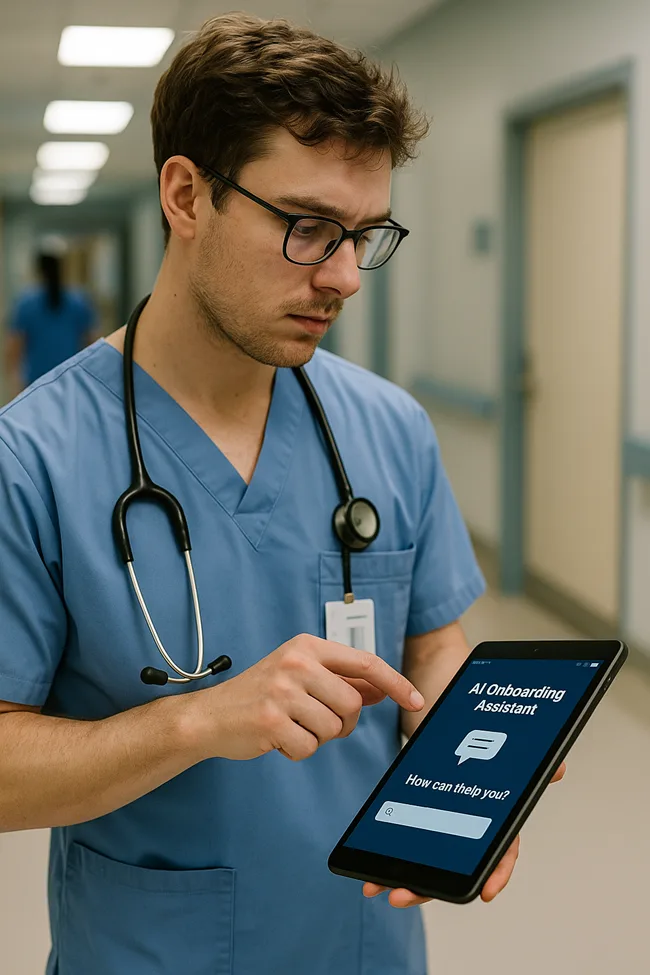
C8 Health is betting that hospitals need more than just policy binders and static PDFs to onboard clinicians in 2025. Its AI-powered assistant—part of the broader best practices implementation platform recently backed by a $12 million Series A round—offers natural-language access to site-specific clinical knowledge for new physicians, traveling nurses, and residents as they rotate through hospitals.
In a healthcare system where care quality often suffers from variability and siloed knowledge, C8 Health is positioning its AI assistant as a frontline onboarding tool that shortens the learning curve for transient or junior medical staff. The platform is already used in over 100 U.S. hospitals and achieves more than 90% clinician adoption within six months of rollout—an unusually high figure in healthtech adoption cycles.
How does the C8 Health AI assistant simplify training and protocol adherence for new clinicians?
The American healthtech company’s assistant isn’t just a chatbot layered on a knowledge base. It draws from each institution’s vetted protocols, departmental SOPs, and locally relevant best practices. When a nurse or resident starts a new shift or rotates to an unfamiliar hospital, the assistant delivers contextual responses to real-time queries like “What’s the sepsis protocol in the ICU?” or “How do I titrate insulin in this ward?”
This AI assistant adapts to a clinician’s role, department, and even time of day—surfacing different workflows depending on whether someone is starting a night shift in the ED or covering anesthesiology rounds during peak surgery hours. The integration with EMRs and mobile apps ensures that access is frictionless and immediate.
Industry observers say this type of point-of-care knowledge delivery could be a game-changer, especially given the staffing volatility hospitals face today. More than 1.5 million traveling nurses and 40,000 new residents enter clinical environments each year in the U.S., often with limited onboarding time.
By embedding onboarding into the clinical workflow, C8 Health reduces time-to-competence—a key metric that many hospital administrators track during orientation cycles.
Could C8 Health’s AI become a broader clinical knowledge hub beyond onboarding?
Analysts suggest that while onboarding is a high-need use case, the assistant’s real long-term value may lie in continuous learning and quality improvement. Since it connects clinicians not just to their own hospital’s protocols but also to a peer-contributed network of best practices from global institutions, it effectively builds an always-on training environment.
For institutions like Dartmouth Health and Metro Health, both of which have adopted the C8 platform, the assistant supports not only training but also real-time quality feedback. This enables clinicians to measure their adherence to protocols on a daily basis rather than waiting for retrospective quality audits.
The company’s leadership—backed by investors including Team8, Vertex Ventures Israel, and 10D—believes the assistant can help shift healthcare culture from static training modules to dynamic, just-in-time education embedded into clinical flow.
What does the rise of AI onboarding tools mean for hospital operations?
The popularity of C8 Health’s assistant coincides with broader trends in hospital workforce management. With increased burnout, shortened tenures, and the rise of telehealth and mobile clinicians, healthcare systems are looking for scalable ways to maintain care quality regardless of who is on shift.
AI onboarding tools like C8’s could help standardize protocols even when staff change daily. In a time where care inconsistency leads to over $300 billion in annual waste, tools that accelerate consistency from Day 1 are receiving close attention.
Institutional sentiment around such tools is increasingly positive, with CIOs and CMOs noting that embedded, AI-driven education may help reduce the performance variability of rotating staff—a key risk factor in emergency, ICU, and surgical environments.
Whether C8 Health’s assistant becomes the definitive standard is still playing out. But its early adoption metrics and focus on bridging the care-practice gap suggest it’s setting a strong precedent for how AI could reshape clinician onboarding in high-stakes settings.
Discover more from Business-News-Today.com
Subscribe to get the latest posts sent to your email.