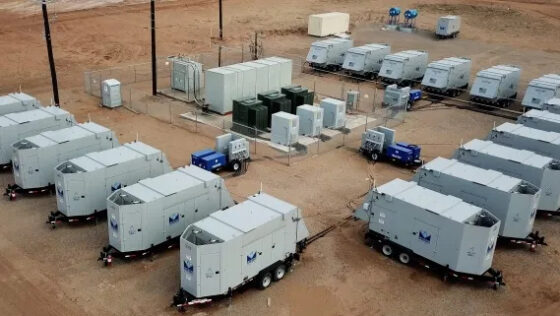




Fermi America has announced a strategic partnership with Hyundai Engineering & Construction Co., Ltd. (KRX: 000720), selecting the South Korean engineering giant to co-develop the nuclear power component of its ambitious private grid initiative intended to power next-generation artificial intelligence infrastructure. This move, formalized through a memorandum of understanding (MOU) signed in Seoul, marks a key milestone in Fermi America’s plan to build what it claims will be the largest private energy grid in the world, delivering up to 11 gigawatts (GW) through a hybrid mix of advanced nuclear, natural gas, solar, battery storage, and data center infrastructure.
Why is Fermi America building a private energy grid for AI?
Fermi America’s proposed energy platform, backed by the Texas Tech University System and co-founded by energy entrepreneur Toby Neugebauer, is a response to the surging power demands of AI model training and data center operations. According to the International Energy Agency (IEA), data center electricity demand is expected to double by 2026, primarily driven by hyperscale AI compute clusters, prompting a global race to secure scalable, low-carbon energy solutions.
This project—unprecedented in scale and scope for a privately owned grid—positions Fermi America at the center of the energy-AI nexus, combining utility-scale generation with real-time flexibility. Its inclusion of new nuclear energy reflects the sector’s shifting consensus that only baseload power such as nuclear can meet AI’s 24/7 demand profile without compromising climate goals.
Hyundai E&C brings deep nuclear build expertise to U.S. soil
Hyundai Engineering & Construction, a subsidiary of Hyundai Motor Group, brings extensive global experience to the table. It has successfully delivered 18 nuclear reactors in South Korea and four additional units in the United Arab Emirates under the Barakah Nuclear Power Plant project—widely regarded as one of the most successful international nuclear builds in recent decades. The Barakah units were delivered safely, ahead of schedule, and under budget, according to public statements and corroborated by the World Nuclear Association.
With four more reactors currently in development in Korea and Bulgaria, Hyundai’s involvement is expected to significantly compress Fermi America’s timeline, particularly on engineering, procurement, and construction (EPC) execution. Hyundai E&C CEO Hanwoo Lee emphasized the value of continuity in nuclear project teams, stating that Fermi America’s leadership includes veterans from recent new-build projects—a likely reference to executives formerly associated with the Barakah development.
What does the MOU between Fermi America and Hyundai E&C cover?
Under the terms of the MOU, Hyundai E&C and Fermi America will jointly plan and develop the nuclear element of the hybrid private grid. The agreement includes phased feasibility studies, front-end engineering design (FEED), detailed project business planning, and execution of EPC works. Both companies have expressed intent to accelerate construction readiness, with ground expected to break in 2026.
Fermi America submitted its Combined Operating License Application (COLA) for AP1000 nuclear reactors to U.S. regulators in June 2025. The Nuclear Regulatory Commission (NRC) accepted the submission in record time—a move seen by industry observers as signaling strong federal support for new nuclear innovation in the context of national energy resilience and AI competitiveness.
Nuclear power’s role in powering artificial intelligence
While most AI-related power discussions have centered around hyperscale data center developers like Microsoft, Google, and Amazon, Fermi America’s vertically integrated approach stands out. Rather than relying on grid operators or renewable power purchase agreements, the company aims to build a dedicated, multi-source generation system with firm power characteristics.
At 11 GW, the grid would rival the entire peak load of countries like Portugal or New Zealand, according to IEA benchmarks. Within this framework, the nuclear component is expected to provide a stable baseload foundation, potentially enabling advanced AI workloads to operate with minimal interruptions or curtailments.
AP1000 technology, designed by Westinghouse Electric Company, offers modular construction advantages and passive safety systems. Though its deployment has historically faced delays and cost overruns in the U.S.—notably at the Vogtle site in Georgia—its successful commercial operation in China and regulatory streamlining in recent years have renewed global interest. Hyundai E&C’s prior experience with AP1000 components and comparable technologies further enhances project credibility.
How are investors and policymakers responding to the announcement?
The MOU has generated considerable interest across institutional investor and infrastructure development circles. While Fermi America is privately held, industry analysts note that the firm’s partnerships with both Texas public institutions and now Hyundai E&C reflect mounting public-private momentum behind nuclear innovation as a national strategic asset. The U.S. Department of Energy (DOE) has also been promoting small modular reactors (SMRs) and next-gen builds through tax incentives and financing tools under the Inflation Reduction Act (IRA).
With rising AI workloads putting pressure on regional grids—from Virginia to Northern California—analysts view Fermi America’s approach as a potential blueprint for other AI infrastructure developers seeking energy autonomy. While no specific investment figures have been disclosed, market speculation suggests the capital investment required for the 11 GW grid—including nuclear—could exceed $30 billion over the life of the buildout.
Sector comparison: How does this align with broader energy-AI trends?
Fermi America’s grid proposal lands at a time when global energy players are rapidly reevaluating their strategies for AI readiness. Google recently signed multi-gigawatt PPA deals tied to geothermal and advanced solar. Microsoft has initiated nuclear partnerships with Terra Praxis and Helion Energy. Meanwhile, utilities like Duke Energy and NextEra are actively modeling AI-driven load growth scenarios into their long-term plans.
Fermi’s grid, if completed as planned, could outsize even the largest of these initiatives in centralized power terms, though companies like Amazon remain far ahead on distributed renewables. The inclusion of AP1000 reactors, in contrast, tilts the project toward long-term infrastructure financing and operational stability.
What’s next for the Fermi-Hyundai nuclear initiative?
With the COLA already accepted by regulators and Hyundai E&C onboard, the next phase involves finalizing FEED studies and site-specific environmental reviews. Fermi America intends to begin early site works and civil construction activities in 2026, targeting reactor operation by 2032. The long lead time is standard in nuclear infrastructure, but the company has indicated that Hyundai’s global procurement efficiencies could potentially compress delivery by several quarters.
Simultaneously, stakeholder consultations are expected to intensify, especially regarding safety, licensing, and local community engagement. Given the location in Amarillo, Texas—a region historically favorable to energy projects and with a growing tech corridor—analysts anticipate limited resistance, especially if federal loan guarantees or state-level incentives are introduced.
Early sentiment from energy equity analysts and grid-scale infrastructure investors is cautiously optimistic. The involvement of Hyundai E&C adds technical depth and timeline discipline, while the focus on AI-aligned energy reliability aligns with macro investment trends.
How this nuclear-AI grid collaboration could reshape U.S. energy narratives
If successfully executed, the Fermi-Hyundai partnership could help reposition nuclear power not just as a decarbonization tool but as a strategic enabler of America’s AI competitiveness. By embedding clean, scalable, 24/7 power into the infrastructure stack supporting machine learning, the project offers a new blueprint for how power markets and digital transformation agendas could intersect.
While questions remain—particularly around cost-sharing, permitting, and grid interconnection—industry observers note that this is one of the clearest commercial signals yet that advanced nuclear is being taken seriously by next-gen infrastructure builders.
As data continues to become the new oil, Fermi America’s bet on nuclear as the backbone of AI power may redefine how utilities, developers, and regulators approach energy planning for the next decade.
Discover more from Business-News-Today.com
Subscribe to get the latest posts sent to your email.