






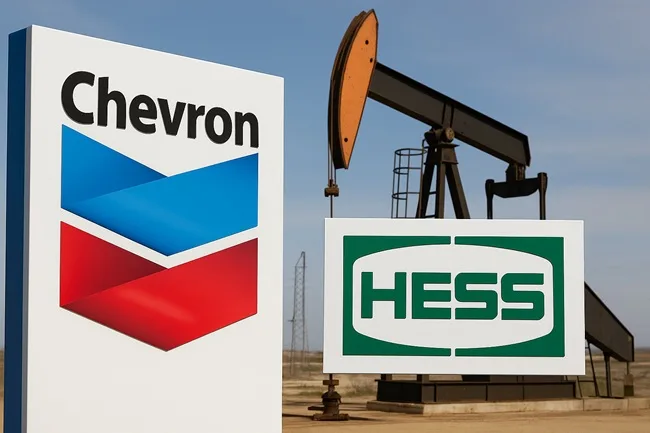
Chevron Corporation (NYSE: CVX) has officially closed its $55 billion acquisition of Hess Corporation (NYSE: HES) on July 18, 2025, marking one of the most significant energy consolidation deals of the decade. The closure followed the settlement of all regulatory and legal conditions, including a decisive arbitration ruling that cleared the way for Chevron to acquire Hess’s prized 30 percent stake in Guyana’s offshore Stabroek Block. With this merger, Chevron strengthens its position in high-margin assets such as Guyana and the U.S. Bakken shale while bolstering its long-term production growth and free cash flow outlook well into the 2030s.
The deal, first announced in October 2023, was valued at $53 billion in stock or about $60 billion including debt. It faced multiple delays caused by arbitration initiated by Exxon Mobil and China National Offshore Oil Corporation, who argued that they held preemptive rights to Hess’s Guyana stake. On July 11, a Paris-based International Chamber of Commerce tribunal rejected those claims, paving the way for completion. This resolution, combined with recent Federal Trade Commission approval, now places Chevron among the strongest global oil producers by reserve growth and cash margin profile.
Why did arbitration over Guyana’s Stabroek Block delay the Chevron–Hess merger and what was finally decided?
The legal challenge focused on Hess’s 30 percent stake in the Stabroek Block, home to one of the world’s largest oil discoveries in the last decade, with more than 11 billion barrels of recoverable resource. Exxon Mobil, the operator with a 45 percent stake, and its partner China National Offshore Oil Corporation claimed a contractual right of first refusal. Industry observers noted that losing access to Guyana would have significantly undermined the strategic rationale for Chevron’s acquisition.
The arbitration panel ultimately ruled that Hess’s sale to Chevron did not violate the joint operating agreement. According to institutional energy analysts, this decision not only secures Chevron’s entry into Guyana’s booming offshore industry but also eliminates what many regarded as the single largest legal risk facing the transaction. Chevron executives have emphasized that the Stabroek Block’s low-cost, high-margin production is expected to be a major driver of free cash flow growth through 2030.
What financial structure and synergy targets make this acquisition transformative for Chevron’s cash flow outlook?
Under the agreed terms, Hess shareholders will receive 1.025 Chevron shares for each Hess share, resulting in Chevron issuing approximately 301 million shares from its treasury. Around 15.38 million Hess shares already owned by Chevron were cancelled at no consideration. Chevron projects that the combined entity will deliver $1 billion in annual run-rate cost synergies by the end of 2025.
The capital expenditure plan for the merged business remains in the $19–22 billion range annually, but Chevron executives stress that this spend will be highly capital-efficient. The company expects the deal to be accretive to free cash flow per share beginning in 2025, coinciding with the start-up of Guyana’s fourth floating production storage and offloading (FPSO) vessel. Analysts believe this cash flow boost provides Chevron with greater headroom for share repurchases and dividend hikes, key factors in sustaining investor confidence during an era of energy transition and volatile oil prices.
How do Guyana and Bakken assets strengthen Chevron’s reserves and long-term production profile?
Guyana’s Stabroek Block is widely regarded as one of the energy industry’s most valuable discoveries, boasting exceptional cash margins and low carbon intensity. With its 30 percent stake, Chevron now holds a direct line to a resource that could anchor its production growth for decades. The Bakken acquisition adds approximately 463,000 net acres of high-quality shale inventory, further diversifying Chevron’s U.S. onshore portfolio alongside its Permian and DJ Basin positions.
Complementing these core assets are 31,000 barrels of oil equivalent per day from Gulf of Mexico operations and 57,000 boe/d in natural gas production across Southeast Asia. Analysts say this diversification significantly strengthens Chevron’s reserve replacement ratio, which had been declining to around 9.8 billion barrels of oil equivalent at the end of 2024. With the integration of Hess’s assets, Chevron’s production is projected to reach roughly 4.31 million boe/d by 2030, aligning it competitively with other global majors such as Shell and TotalEnergies.
What are institutional investors saying about Chevron’s growth prospects post-acquisition?
Institutional investors largely view the acquisition as a decisive move to secure long-term cash flow resilience. Despite Chevron’s stock losing approximately 7.5 percent over the past year, attributed to broader sector volatility and regional geopolitical risks, energy-focused funds see this transaction as a turning point. Analysts suggest that Chevron’s ability to sustain double-digit returns on capital employed, coupled with Guyana’s low breakeven costs, could restore confidence in its valuation multiples over the next 12–18 months.
Some institutional sentiment also highlights the strategic timing: with global demand expected to grow steadily despite energy transition pressures, owning one of the world’s fastest-growing offshore oil developments ensures Chevron remains competitive in meeting both shareholder and market expectations.
What changes to Chevron’s board and governance followed the FTC’s reversal of its restriction?
The Federal Trade Commission voted unanimously on July 17, 2025, to lift its earlier restriction preventing John Hess from joining Chevron’s board of directors. The original limitation had been imposed due to perceived antitrust concerns related to OPEC-aligned strategies, but Chevron and Hess petitioned for a review in March 2025, arguing that those concerns were outdated. Once approved by Chevron’s board, John Hess’s appointment is expected to bring deep expertise in global exploration and production strategies, which institutional investors believe could aid Chevron’s operational and geopolitical risk management.
What future developments should investors expect as Chevron integrates Hess assets?
Chevron’s focus over the next 12–18 months will be on rapid integration, with management targeting full synergy realization by late 2025. Analysts expect increased cash distributions to shareholders, with potential dividend growth beyond the $1.63 per share mark proposed earlier this year and share repurchases possibly exceeding the current $20 billion annual guidance if oil prices remain favorable.
Additionally, Chevron is expected to accelerate development timelines in Guyana, potentially sanctioning additional FPSO vessels sooner than previously anticipated. Institutional observers believe that sustained progress in Guyana and efficiency gains in the Bakken will be critical in ensuring Chevron meets its long-term goal of extending production and free cash flow growth well into the 2030s.
Chevron’s successful arbitration victory and completion of this landmark acquisition cement its position as one of the most strategically diversified oil producers globally. With access to high-margin, low-carbon intensity resources and a robust production pipeline, the integrated Chevron–Hess entity is poised to shape the energy landscape for years to come.
Share this:
Discover more from Business-News-Today.com
Subscribe to get the latest posts sent to your email.
