




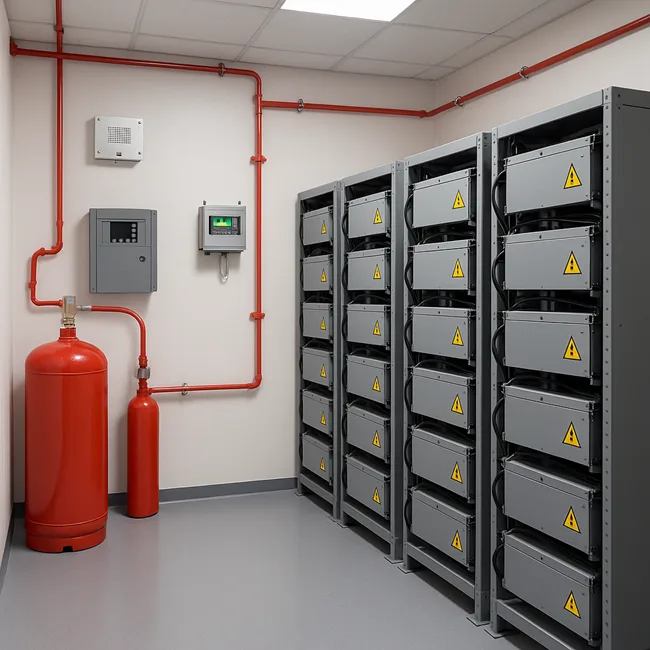
Honeywell International Inc.’s acquisition of Nexceris’ Li-ion Tamer battery off-gas monitoring technology has reignited debate on whether battery fire safety is emerging as a key growth frontier for building automation providers. The deal, announced on July 15, 2025, folds the industry-leading lithium-ion thermal runaway detection system into Honeywell’s Building Automation portfolio. With global energy storage deployments scaling rapidly, this move signals that fire safety technology, once considered a niche risk mitigation tool, is now becoming a core competitive differentiator in building automation.
Why are building automation providers accelerating investments in lithium-ion battery fire safety solutions in 2025?
The rising adoption of energy storage systems, electric vehicle charging hubs, and on-site backup power in commercial buildings has elevated fire safety concerns. Lithium-ion batteries, while efficient, carry inherent thermal runaway risks. Off-gas monitoring solutions like Li-ion Tamer offer early detection of volatile gases released before a cell enters full thermal runaway, giving facility managers critical time to isolate and prevent catastrophic fires. Honeywell’s integration of this technology into its broader Connected Life Safety Services and VESDA smoke detection suite highlights how battery fire safety is shifting from a standalone product to a fully integrated building automation feature.
Industry experts suggest this is not just about regulatory compliance but also about insurance and operational continuity. As energy-intensive facilities such as data centers, hospitals, and manufacturing plants adopt lithium-ion storage, insurers are pushing for advanced fire detection systems as a prerequisite for coverage. Analysts also believe that companies with integrated battery fire safety solutions will have a pricing advantage in winning commercial building automation contracts, especially as battery installations become part of green building certifications.
Honeywell is not alone in this push. Global building automation players such as Siemens, Schneider Electric, and Johnson Controls are also increasing their focus on fire and thermal safety technologies. Recent investments in connected sensors, gas detection systems, and AI-based predictive maintenance are part of a larger trend where building automation platforms evolve into holistic risk management systems.
The growth opportunity is significant. Market estimates project the global energy storage market to exceed US$400 billion by 2030, with building-integrated systems forming a substantial share. Battery fire safety, once a supplementary offering, is expected to see double-digit annual growth rates as energy storage becomes a standard feature of commercial and residential buildings.
What strategic implications does this have for building automation players entering the battery safety space?
Building automation providers are increasingly positioning themselves as end-to-end energy and safety partners rather than just HVAC or lighting specialists. By adding battery fire safety into their portfolios, they can leverage existing customer relationships and sell integrated solutions that combine energy efficiency, security, and fire risk mitigation. Honeywell’s move underscores this shift, as it can now cross-sell battery fire safety monitoring through its existing building automation service contracts, adding a recurring revenue layer.
From a strategic standpoint, early movers could establish long-term dominance as battery fire safety evolves into a critical compliance requirement. Facilities managers, under pressure to meet sustainability and ESG targets, are adopting energy storage systems but are simultaneously wary of associated fire risks. Building automation providers that can offer a seamless, certified safety package are likely to win large-scale tenders for smart building projects, particularly in regulated markets like the U.S., EU, and Japan.
Institutional sentiment is also turning supportive of this trend. While Honeywell’s acquisition was a bolt-on rather than a large transformative deal, investors are showing greater interest in companies combining software-driven safety analytics with hardware innovation. Analysts argue that battery safety will likely become an essential module in next-generation smart building platforms, giving diversified automation providers an edge over niche fire safety manufacturers.
What does the future look like for battery fire safety in the building automation ecosystem?
Battery fire safety is moving from a reactive to a predictive model. Over the next five years, building automation providers are expected to integrate off-gas detection with cloud-based analytics, enabling predictive maintenance and automated system shutdowns. Honeywell’s strategy of combining Li-ion Tamer with its Honeywell Forge IoT platform is an early example of this convergence.
In the long term, building automation companies could extend these solutions to other high-risk environments, such as electric vehicle charging hubs, microgrids, and even maritime battery systems. As energy storage scales globally and regulations tighten, battery fire safety could evolve into a billion-dollar sub-segment within the building automation industry. For providers like Honeywell, Siemens, and Johnson Controls, early investment in this frontier may secure long-term leadership in a market where safety and sustainability are increasingly intertwined.
Discover more from Business-News-Today.com
Subscribe to get the latest posts sent to your email.

