How did the Texas Hill Country floods turn deadly despite weather warnings?
At least 129 people have been confirmed dead and more than 170 are still missing after catastrophic flash flooding engulfed the Texas Hill Country in early July 2025. The storm’s destruction was most severe in Kerr County, where the Guadalupe River rose over 37 feet within an hour, driven by remnants of Tropical Storm Barry. According to county officials, 36 children were among the dead, including 27 campers from Camp Mystic, in one of the deadliest U.S. flood disasters in decades.
Search and rescue operations are ongoing, with President Donald Trump declaring a federal disaster and dispatching FEMA teams to bolster state response. Trump visited the flood zone on July 11, calling the destruction “beyond comprehension” and pledging federal aid “for as long as it takes.”
But as the nation mourns, questions are mounting over why so many residents received no warning—and why one of America’s most flood-prone regions still lacks adequate alert infrastructure.
Why were flood alerts delayed and how did that contribute to the high death toll?
Though the National Weather Service issued flash flood warnings as early as July 4, Kerr County did not activate the federal IPAWS (Integrated Public Alert and Warning System), which could have sent emergency alerts directly to mobile devices. Instead, it relied on voluntary opt-in services like CodeRED, which reached only a fraction of residents. According to FEMA records, the county did not send any Emergency Alert System (EAS) messages before the flood surge, nor did it activate civil warning sirens—because none exist.
That communication breakdown had tragic consequences. Survivors described waking up to rising water with no time to flee. Many of the deceased were found in low-lying homes, mobile units, or outdoor campsites with limited cell service. Emergency planners had reportedly requested $1 million in funding for sirens in a 2022 proposal, which was ultimately denied due to budget constraints.
What has the emergency and federal response looked like in the days following the disaster?
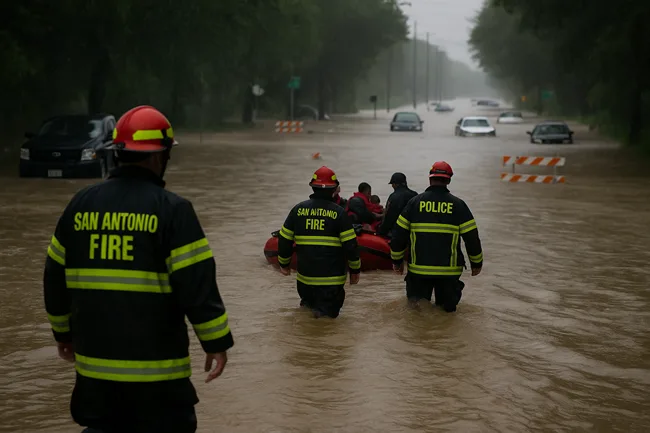
Within hours of the July 7 peak flooding, local emergency services, Texas DPS, and the National Guard launched search operations. Over 850 people have been rescued, including many airlifted from rooftops and trees. Rescue teams from across the U.S.—and even from Mexico—have joined recovery efforts.
In parallel, FEMA is coordinating housing, medical, and recovery resources, with emergency funds released under the national disaster declaration. The American Red Cross, Mercy Chefs, and World Central Kitchen are among the NGOs providing essential services on the ground.
Yet federal officials acknowledge that long-term recovery will take months. Infrastructure damage across Kerr, Burnet, and Llano counties includes washed-out roads, collapsed bridges, and compromised water systems.
What are officials and communities doing to support survivors and commemorate the dead?
The human cost has sparked an outpouring of grief and community support. Candlelight vigils have been held in Kerrville, Fredericksburg, and Boerne, with many honoring the victims by name. On July 27, George Strait is scheduled to headline a benefit concert in Boerne, with proceeds directed toward families of flood victims and displaced residents.
Grocery retailer H-E-B, regional banks, and local businesses have launched relief drives and donated food, clothing, and temporary shelter. Community churches have also stepped in to house survivors and host mental health counselors for bereaved families.
How is climate change contributing to extreme weather in “Flash Flood Alley”?
The Texas Hill Country sits in a zone long known as “Flash Flood Alley”, but climate scientists say the intensity of the July 2025 storm was amplified by climate warming. Warmer air holds more moisture, and when combined with slow-moving tropical remnants like Barry, the results can be devastating.
Rainfall exceeded 20 inches in some areas within 72 hours—more than four months’ worth of precipitation in a typical season. Meteorologists called the resulting flash floods “textbook examples” of how climate change is increasing the frequency and ferocity of rain-on-dry-land events in semi-arid regions.
What policy changes are expected after the disaster and how are lawmakers responding?
Governor Greg Abbott has called a special session of the Texas Legislature focused on disaster preparedness, including funding for alert systems, streamlining local-federal coordination, and improving river basin monitoring infrastructure.
State lawmakers are also proposing mandatory adoption of IPAWS protocols and a standard minimum alerting capability for all counties within high-risk flood zones. The proposals come after years of inconsistent implementation, as local jurisdictions have maintained wide autonomy over emergency communications.
At the federal level, members of Congress from both parties are advocating for a renewed national flood mitigation bill that includes grants for early-warning technology, rural siren systems, and climate resilience planning.
Could this tragedy trigger a long-overdue shift in disaster communication standards?
Emergency management experts believe the Texas floods may become a watershed moment in U.S. disaster communication reform. The absence of basic infrastructure in a flood-vulnerable region has laid bare the uneven patchwork of preparedness across rural America.
Experts at the University of Colorado’s Natural Hazards Center have recommended a federal baseline alert standard, in which all counties must be able to issue IPAWS-level alerts within 10 minutes of NWS warnings. They argue that current inconsistencies not only risk lives but also undermine public trust in official emergency messaging.
If adopted, these reforms would mark the most significant shift in U.S. emergency alert policy since the Wireless Emergency Alerts system went live in 2012.
What’s next for survivors, responders, and state leaders in the Texas Hill Country?
For now, the focus remains on search, recovery, and healing. But as the floodwaters recede, a deeper reckoning is underway—about infrastructure, governance, and the human cost of inaction.
In many parts of the Hill Country, families will be rebuilding not just homes but livelihoods. Local leaders are urging state and federal authorities to prioritize long-term investments in both physical and digital resilience, from elevated bridges and embankments to redundant alert systems and AI-driven flood forecasting.
President Trump’s administration has indicated openness to FEMA budget increases and climate resilience projects in red states—a notable shift from his 2024 campaign rhetoric. Whether this policy softening will materialize into structural changes remains to be seen.
Discover more from Business-News-Today.com
Subscribe to get the latest posts sent to your email.