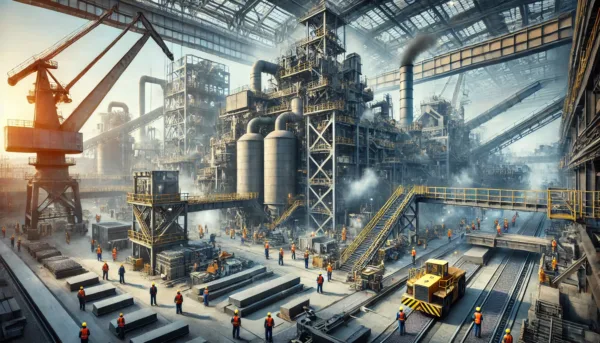
Hilco Industrial, a global leader in industrial asset sales and advisory, announced on July 8, 2025, that it has entered into a landmark agreement with Japanese steelmaking giant JFE Steel Corporation for the international resale of multiple heavy-duty production lines from the EAST JAPAN Works facilities located across Keihin, Ohgishima, and Mizue-Kawasaki. The contract was executed in partnership with SEALS Co., Ltd, a Japan-based asset marketing specialist, and marks one of the most significant industrial divestment programs in the region in recent years.
This agreement enables Hilco Industrial and SEALS Co., Ltd to bring to market an integrated suite of large-scale assets, including a 2,300 mm Wide Hot Strip Mill, Coil Galvanizing Lines No. 2 and 3 (each equipped with Skin-Pass Mills), a Coil Preparation Line, and a combined Pickling Line and Tandem Cold Mill. These assets, historically deployed to manufacture high-specification flat steel products, are now being offered to global buyers as part of JFE Steel Corporation’s portfolio rationalization and modernization strategy.
Institutional investors and analysts interpret the sale as a carefully timed move, signaling JFE Steel Corporation’s intent to exit aging, capital-intensive operations and reallocate resources toward greener, more technologically advanced production capacity.
What production lines are included in the Hilco–JFE Steel deal and why are they seen as highly strategic by global steel players?
The assets involved in the divestiture represent the full upstream-to-finishing chain required for premium-grade flat steel production. These include a Wide Hot Strip Mill capable of processing coils up to 2,300 mm wide—a specification frequently used in automotive, industrial, and construction-grade steel—and two galvanizing lines featuring high-capacity furnaces, air knife wiping systems, and Skin-Pass finishing mills for corrosion-resistant output.
Also included is a Coil Preparation Line, critical for precision tasks such as shearing, welding, and straightening prior to cold rolling. The Pickling Line and Tandem Cold Mill, typically coupled in modern finishing operations, provide enhanced surface treatment and gauge control for downstream applications.
Analysts have described the suite as “turnkey infrastructure” that could significantly reduce time-to-operation for buyers, especially in markets like Southeast Asia and South America where demand for intermediate steel inputs is rising but local manufacturing capacity remains underdeveloped.
What are the expected financial and operational outcomes for Hilco Industrial and SEALS Co., Ltd from this industrial asset transaction?
While the exact financial terms have not been disclosed, advisory transactions of this nature typically generate performance-based success fees for firms such as Hilco Industrial and SEALS Co., Ltd. Revenue is tied to both the complexity of disassembly logistics and the eventual sale value of the equipment, which could range from tens to hundreds of millions of dollars depending on buyer interest and reuse potential.
JFE Steel Corporation, one of the top integrated steel producers in Japan, is expected to redirect proceeds from this asset sale toward balance sheet improvements and modernization initiatives at its flagship plants in Fukuyama and Chiba. Institutional sentiment has framed the divestment as a strategic realignment rather than a distressed exit, indicating that proceeds will likely support capital expenditures on low-carbon technologies and digital process controls.
How does this asset divestment align with JFE Steel Corporation’s long-term decarbonization and restructuring strategy?
JFE Steel Corporation has been progressively repositioning itself to meet Japan’s ambitious decarbonization targets, with the Japanese government aiming for net-zero carbon emissions by 2050. As part of this effort, legacy blast furnace operations have come under review for their energy intensity and high maintenance cost structure.
Analysts believe that the asset sale is a calculated move to consolidate production around fewer, more efficient locations, potentially replacing aging lines with electric arc furnace (EAF) operations or green steel pilot programs. This realignment reflects a broader trend in the global steel sector: reducing overcapacity, cutting emissions, and deploying capital into modular, scalable, and lower-emission plants.
Why are global steel producers and infrastructure investors closely monitoring this sale?
For steelmakers in developing economies or regions undergoing infrastructure expansion, this sale presents an opportunity to acquire fully functional production lines without the prohibitive costs or delays associated with building greenfield plants. By purchasing proven Japanese equipment, buyers can avoid complex procurement cycles and accelerate entry into flat steel or coated sheet markets.
Institutional investors and supply chain specialists view such acquisitions as de-risked capex plays—especially when bundled with technical commissioning support from Hilco Industrial or SEALS Co., Ltd. Analysts have noted that similar past sales have resulted in rapid plant redeployments in Vietnam, Turkey, and Brazil, helping to stabilize regional supply chains while generating attractive returns on capital for asset buyers.
What is the prevailing expert sentiment about the timing and strategic rationale behind this divestiture?
Institutional sentiment has largely been favorable, with many experts pointing out that global steel prices have stabilized after the post-pandemic volatility of 2022–2024. JFE Steel Corporation’s decision to divest now, during a relatively balanced market environment, allows the company to maximize asset value without appearing reactive or distressed.
Moreover, as global pressure mounts on carbon-intensive sectors to decarbonize, asset-light models are increasingly viewed as fiscally prudent. Analysts say this deal may set a precedent for other legacy operators to unlock capital trapped in underutilized or outdated production infrastructure.
What should industry observers expect next as the Hilco–SEALS–JFE asset sale progresses through 2025?
Observers should monitor bidding activity across major steel-producing regions, including the potential for consortium-led acquisitions by regional champions or sovereign-linked buyers. The logistics of disassembly, shipping, and recommissioning will also offer clues about the appetite and urgency of acquirers. There is additional speculation that Hilco Industrial could package the sale with refurbishment services or offer leasing models in coordination with local financing partners.
In parallel, analysts anticipate that JFE Steel Corporation may disclose further rationalization or automation upgrades at its other Japanese sites, particularly in relation to electric furnace expansion or hydrogen-based steelmaking trials.
What does the Hilco Industrial–JFE Steel asset sale signal about the future of global steel capacity?
The strategic sale of critical steel production assets from JFE Steel Corporation’s EAST JAPAN Works to the global market via Hilco Industrial and SEALS Co., Ltd underscores a pivotal shift in how legacy steelmakers are approaching operational modernization. It also illustrates how industrial asset advisory firms are playing a growing role in shaping global supply chains by matching surplus capacity with underserved regional markets. While financial terms remain private, the broader market implications—reduced carbon intensity, optimized capital allocation, and accelerated industrial expansion elsewhere—are already resonating through the global steel industry.
Discover more from Business-News-Today.com
Subscribe to get the latest posts sent to your email.