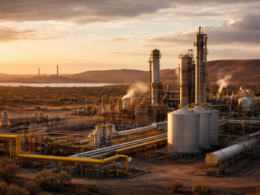



Gradiant, the Boston-headquartered industrial water and resource recovery company, has announced a landmark development in the U.S. energy and battery materials landscape. Through its lithium-focused subsidiary alkaLi, Gradiant will design, build, own, and operate the world’s first fully integrated lithium production facility capable of extracting, concentrating, and converting lithium (via the EC² process) from oilfield produced water. This commercial-scale plant, located in the Marcellus Shale Formation of Pennsylvania, is slated for launch by early 2026 and represents a significant step toward establishing a resilient, domestic battery materials supply chain.
In a sector traditionally dominated by hard-rock mining in Australia and brine evaporation ponds in South America, alkaLi’s end-to-end model stands out for both technological novelty and environmental adaptability. The move arrives as automakers, battery manufacturers, and energy storage firms scramble to secure long-term lithium supply amid regulatory tailwinds from the U.S. Inflation Reduction Act and the Department of Energy’s critical minerals strategy.
What Is Gradiant’s EC² Process and Why Does It Matter for U.S. Lithium Independence?
Gradiant’s patented EC² (Extract, Concentrate, Convert) technology lies at the heart of the project’s disruptive potential. The platform combines Direct Lithium Extraction (DLE), downstream concentration, and final lithium carbonate conversion into a modular, AI-enhanced system that can be deployed at or near resource sites—particularly those previously dismissed as nonviable for lithium recovery.
The EC² system achieves up to 97% lithium recovery efficiency from oilfield brines and delivers battery-grade lithium carbonate at 99.5% purity. By comparison, traditional South American brine operations often require 12–24 months of evaporation, extensive land use, and complex permitting processes, with final purity outcomes highly sensitive to ambient climate and brine chemistry. The modularity of EC² also allows for rapid scaling, reduced capital intensity, and improved lifecycle cost competitiveness.
Beyond performance, EC² offers feedstock flexibility that includes geothermal brines, battery recycling leachate, and unconventional water sources—signaling future adaptability beyond oilfield-produced water. This flexibility positions alkaLi to deploy its systems across various regions with diverse lithium-bearing chemistries, enabling it to become a technology-first solution provider in a space traditionally bound to geological limitations.
Why Did Gradiant Choose the Marcellus Shale for the First Commercial EC² Facility?
Gradiant’s decision to locate its first full-scale EC² plant in Pennsylvania’s Marcellus Shale is underpinned by both geological and regulatory rationales. The Marcellus Formation is one of the largest and most productive shale basins in North America, responsible for more than one-third of the U.S.’s natural gas output. It generates billions of gallons of produced water annually, often treated as a disposal liability.
By transforming this waste stream into a feedstock, alkaLi adds value to an overlooked byproduct while reducing the environmental burden of traditional water disposal methods like deep-well injection. Furthermore, Pennsylvania’s existing energy infrastructure, skilled workforce, and favorable permitting frameworks offer operational advantages over lithium-rich but geopolitically complex or regulation-heavy jurisdictions.
Gradiant has secured land rights, mineral rights, and permitting approvals in advance, giving it full ownership and control over the facility’s operational components. This vertical integration is crucial to avoiding delays commonly seen in U.S. critical mineral projects, particularly in states with fragmented permitting regimes or local opposition to industrial projects.
What Is the Strategic Value of alkaLi’s Offtake Agreement with a U.S. Battery Manufacturer?
In a move that validates both the technical viability and commercial appeal of EC², alkaLi has signed a long-term offtake agreement to supply up to 5,000 metric tonnes per year of battery-grade lithium carbonate to a U.S. lithium-ion battery manufacturer. While the buyer remains undisclosed, this contract anchors the project’s economic model and provides much-needed certainty in a market marked by volatile lithium prices and fragmented upstream supply.
Given that the U.S. currently imports over 95% of its lithium chemicals—primarily from Chile, Argentina, China, and Australia—this offtake deal is not just commercially relevant but also geopolitically strategic. It enables the downstream partner to qualify for federal incentives under the Inflation Reduction Act, which favors domestic mineral sourcing, and also hedges against global lithium market instability.
Early industry sentiment suggests this offtake could catalyze further ecosystem-wide partnerships. Investors and policymakers alike are viewing the agreement as an inflection point that transforms alkaLi from a technology demonstrator into a reliable lithium supplier with near-term revenue visibility.
How Is alkaLi Positioning for Future Growth in the Clean Energy Economy?
alkaLi is not merely focused on becoming a lithium producer but is offering its EC² platform across three business models: licensing the technology to resource owners, designing and operating integrated systems for third-party partners, and continuing to develop company-owned lithium production assets.
This multi-pronged approach allows alkaLi to serve upstream extractors, midstream refiners, and downstream battery clients, effectively bridging critical gaps in the current battery value chain. For example, junior mining companies with lithium-rich brines but lacking downstream capabilities can deploy EC² for in-house conversion. Likewise, legacy oil & gas players looking to decarbonize can monetize their produced water under technology-sharing agreements.
The company’s AI-optimized system—capable of predictive maintenance, real-time data analytics, and automated parameter tuning—also aligns with the broader trend toward “smart” industrial operations in the battery and cleantech sectors. Analysts expect Gradiant’s EC² deployments to increase outside Pennsylvania, particularly in geothermal hotspots like Nevada and California or in battery recycling hubs.
Could Gradiant’s Breakthrough Alter Institutional Flows into Lithium and Battery ETFs?
While Gradiant and alkaLi remain privately held, the implications of their Pennsylvania project are already reverberating across the lithium and clean energy investment landscape. Publicly traded lithium companies such as Albemarle Corporation (NYSE: ALB), Livent Corporation (NYSE: LTHM), and Lithium Americas Corp. (NYSE: LAC) have seen increased investor scrutiny over capital expenditure overruns, jurisdictional risk, and environmental compliance.
In contrast, modular and U.S.-based solutions like EC² may draw interest from clean energy-focused ETFs, institutional funds with ESG mandates, and sovereign wealth funds looking to de-risk their lithium exposure. Analysts suggest that as alkaLi’s model gains traction, it could prompt a revaluation of what constitutes “investable lithium” in a world where regulatory, logistical, and sustainability criteria are tightening.
While there is no direct equity access to Gradiant yet, industry insiders believe private equity firms and strategic investors—especially those linked to U.S. automakers or battery alliances—are watching the project closely for potential M&A, joint ventures, or minority investments.
What Is the Broader Industry Context for Gradiant’s Lithium Venture?
The timing of alkaLi’s commercial rollout is significant within the broader arc of the energy transition. Global EV sales are projected to exceed 18 million units in 2025, up from 14 million in 2024, according to the International Energy Agency. Meanwhile, stationary storage demand for grid balancing is expected to double in North America over the next three years.
Lithium carbonate and lithium hydroxide remain foundational chemicals for the cathode materials used in these systems. Yet the U.S. accounts for less than 2% of global lithium production today, creating a bottleneck that threatens national energy independence goals. The Department of Energy has flagged lithium as one of the five most critical materials with supply insecurity risks.
Gradiant’s approach aligns with a growing push to localize supply chains, monetize industrial waste, and apply digital infrastructure to critical minerals processing. EC² may well be the first of many platforms to emerge at the intersection of water technology, energy recovery, and clean manufacturing.
How Will Gradiant’s Project Shape the Future of Lithium Production in the U.S.?
If successful, Gradiant’s Pennsylvania facility will become a blueprint for decentralized, sustainable lithium production at scale. More than just a standalone asset, it represents a transformation in how lithium can be sourced—from waste to value, from centralized to modular, and from environmentally intensive to ESG-compliant.
This shift is not just technological but also philosophical. It challenges the long-standing notion that battery minerals must come from geopolitically sensitive or environmentally contentious regions. Instead, it suggests a future where industrial byproducts are refined into strategic assets via AI, smart engineering, and system-wide integration.
Industry observers expect alkaLi to announce additional sites in the coming quarters, potentially including co-located facilities at oil & gas or geothermal operations. Gradiant’s approach could thus expand lithium access to regions and companies previously excluded from the battery race—fundamentally reshaping the energy storage economy from the ground up.
Discover more from Business-News-Today.com
Subscribe to get the latest posts sent to your email.