



What are the most important enterprise-grade upgrades introduced with Salesforce Agentforce 3?
Salesforce Inc. (NYSE: CRM) introduced Agentforce 3 on June 23, 2025, marking a major upgrade to its digital labor platform. The new release brings enhanced observability through a unified Command Center, full support for the Model Context Protocol (MCP), and architectural improvements under the Atlas framework, all aimed at helping enterprises manage, scale, and govern AI agents more effectively. Positioned as the solution to the enterprise AI scalability gap, Agentforce 3 enables companies to optimize performance, accelerate deployments, and maintain compliance in increasingly complex operational environments.
The update arrives as adoption of AI agents accelerates rapidly. Salesforce reported that usage of agentic AI tools has increased by 233 percent in just six months, with more than 8,000 new customers joining the Agentforce ecosystem. With this release, Salesforce is attempting to convert pilot programs into large-scale production rollouts by addressing three core blockers: lack of observability, difficulty integrating with enterprise tools, and inconsistent agent performance across departments.
How does Agentforce 3 build on Salesforce’s history of enterprise AI integrations?
Salesforce’s AI journey began in 2016 with the launch of Einstein AI, a foundational effort to embed machine learning capabilities into its CRM platform. The October 2024 debut of Agentforce marked a shift toward agentic AI, allowing businesses to automate customer engagement, service interactions, and task orchestration using dedicated AI agents. Agentforce 3 represents the next iteration of that evolution, building on feedback from thousands of deployments over the past eight months. The latest version introduces enterprise-grade telemetry, trust layers, and open-standard integrations that enable CIOs and digital leaders to treat AI agents as scalable, manageable digital teammates.
The upgrade also coincides with a broader trend in enterprise automation, as firms increasingly move from chatbots and point AI tools to orchestration platforms capable of supporting multiple agents across complex workflows. Agentforce 3 positions Salesforce to lead this transformation, especially in highly regulated and operationally intensive industries.
What is the purpose of the new Command Center and how does it improve agent observability?
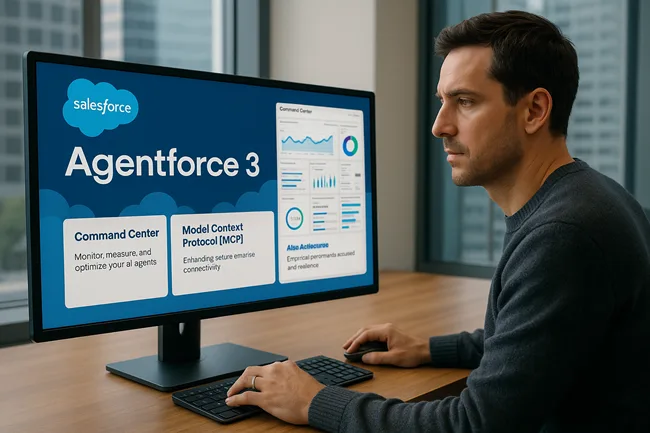
The Command Center is the centerpiece of Salesforce’s new observability layer. Integrated into Agentforce Studio, it allows enterprise users to monitor, measure, and manage AI agent performance in real time. It tracks key metrics such as latency, escalation frequency, error rates, topic performance, and cost impact, enabling business and IT leaders to identify performance trends and optimize agent behavior at scale. Built on OpenTelemetry standards, the platform integrates natively with third-party monitoring tools such as Datadog, Splunk, and Wayfound.
In practical terms, the Command Center gives enterprises a real-time window into their AI workforce. Supervisors can see how agents interact with users, evaluate their effectiveness across use cases, and intervene when anomalies arise. With session-tracing capabilities scheduled to go live in August 2025, the Command Center completes the feedback loop for continuous AI agent improvement, enabling test-before-deploy functionality, proactive optimization, and cost governance.
How does Salesforce’s support for Model Context Protocol enhance enterprise connectivity?
Salesforce’s adoption of Model Context Protocol (MCP) is a major step toward plug-and-play interoperability for AI agents. Often referred to as the “USB-C for AI,” MCP allows agents to securely connect to external applications and tools without needing custom integration code. Agentforce 3 includes a native MCP client that can interact with any compliant server. Through its MuleSoft integration, Salesforce enables enterprises to instantly convert APIs into MCP-compliant services. Meanwhile, Heroku offers secure MCP server hosting, letting developers bring proprietary agent actions into Salesforce workflows with minimal friction.
The expanded AgentExchange ecosystem already features more than 30 MCP-connected partners. Notable launch partners include AWS, Box, Stripe, PayPal, Notion, IBM, and Google Cloud. These integrations allow agents to handle complex enterprise transactions such as document retrieval, compliance audits, subscription management, product listings, and natural language database queries. The result is a fully modular, enterprise-ready AI layer capable of executing end-to-end tasks across distributed IT stacks.
How are customers across industries responding to Agentforce deployment so far?
Enterprise customers have responded positively to Agentforce deployments, citing improvements in operational efficiency, customer service metrics, and speed-to-value. Salesforce reports that Engine reduced its average customer case handle time by 15 percent using Agentforce. Similarly, 1-800Accountant achieved 70 percent autonomous resolution of administrative chats during the 2025 tax season, while Grupo Globo increased subscriber retention by 22 percent after embedding agents into its engagement workflows. These results illustrate how agentic AI can improve both cost metrics and customer loyalty across diverse industries.
Healthcare and consumer sectors are also engaging with Agentforce. UChicago Medicine is automating front-line patient queries to free up clinical staff time, while PepsiCo is using the platform to unify operational insights and enhance customer intelligence. PepsiCo’s Chief Strategy and Transformation Officer, Athina Kanioura, stated that Agentforce has allowed the company to act more strategically across its global operations, citing real-time insights and centralized visibility as major benefits.
What does institutional sentiment reveal about Agentforce’s business potential and CRM stock?
Investor reactions to Agentforce 3 have been mixed. While the product roadmap shows strong alignment with enterprise AI trends, Salesforce’s FY26 guidance disappointed some institutional investors. In February 2025, Salesforce forecast revenue between USD 40.5 billion and USD 40.9 billion, missing consensus estimates of USD 41.35 billion. Analysts partly attributed this miss to slower-than-expected monetization of Agentforce.
Some institutional investors lowered their expectations, citing concerns that Salesforce’s heavy R&D spend on AI agents might dilute focus from its core CRM offerings. However, others see long-term value in the platform. Wolfe Research recently raised its price target to USD 340, highlighting strong partner sentiment and noting that 10 percent of Agentforce pilots have now gone live. They project that broader adoption could materialize by the November earnings cycle, supported by the platform’s simplified pricing and growing use cases.
Salesforce’s Q1 revenue for FY26 came in above expectations at USD 9.83 billion. AI-related product lines, including Data Cloud and Agentforce, posted 120 percent year-over-year growth. The company also reported expanding margins and healthy free cash flow, which have supported share buybacks and new dividend issuances. As of June 24, Salesforce stock trades at USD 270.71, up modestly but still reflecting cautious optimism among investors.
How will the new architecture and pricing model affect adoption and scalability?
Agentforce 3’s underlying Atlas architecture delivers key performance gains, including 50 percent lower latency since January 2025 and support for response streaming. The architecture also adds real-time web search and inline citation capabilities for AI-generated responses, allowing agents to access live information beyond Salesforce’s native data environment. Critically, it now includes automatic model failover, ensuring continuity when primary LLMs face latency spikes or outages.
In terms of infrastructure, Agentforce now supports hosted Anthropic Claude models via Amazon Bedrock within Salesforce’s compliance boundary. Google’s Gemini models are expected to be added later in 2025, providing further flexibility. The platform’s geographic reach has also expanded, with new deployments available in Canada, the United Kingdom, India, Japan, and Brazil. Six new languages—French, German, Spanish, Japanese, Portuguese, and Italian—are now supported, with over 30 more expected in the coming months.
Salesforce has also overhauled Agentforce pricing. It now offers per-user SKUs for Sales Cloud, Service Cloud, and Industry Cloud with unlimited usage of employee-facing actions. Analysts believe this will reduce budget friction and accelerate enterprise adoption, particularly in sectors with large contact center or field operations teams.
What is the near-term and long-term outlook for Salesforce Agentforce?
Over the next 6 to 12 months, institutional investors will be watching closely to see whether Agentforce moves from pilot to enterprise-wide deployment. Upcoming product releases, including the Agentforce Command Center and Heroku AppLink, are scheduled for July and August 2025, respectively. Full FedRAMP High authorization now allows U.S. public sector agencies to adopt the platform, potentially opening a major new revenue stream.
While monetization remains in early stages, most institutional sentiment points to cautious optimism. Salesforce has created the infrastructure and interoperability layer that enterprises have long demanded, especially in sectors where governance and security are non-negotiable. Analysts expect Agentforce to contribute more meaningfully to revenue starting in FY27, assuming successful customer conversions and partner-led scaling.
In the long run, Salesforce’s competitive positioning in agentic AI will depend on its ability to balance openness, control, and speed of execution. As rivals like Microsoft and Google build their own agent platforms, the differentiator may come down to observability, multi-agent coordination, and enterprise compliance readiness—areas where Agentforce 3 is now aggressively investing.
Discover more from Business-News-Today.com
Subscribe to get the latest posts sent to your email.