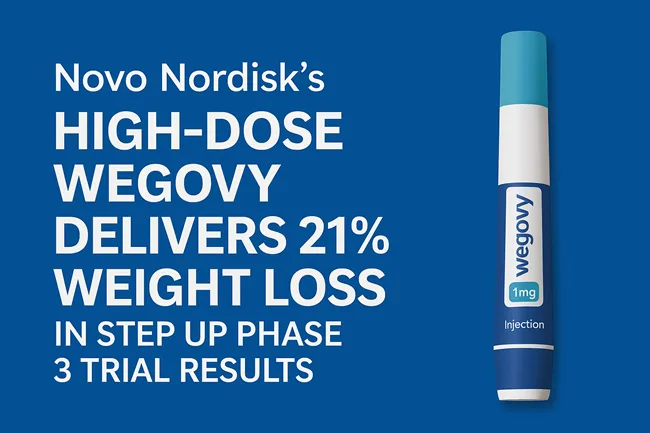
Novo Nordisk A/S (CPH: NOVO-B) has announced Phase 3b results from its STEP UP trial indicating that a higher dose of Wegovy (semaglutide 7.2 mg) achieved an average weight loss of 21% over 72 weeks in adults with obesity. The data, presented at the American Diabetes Association (ADA) Scientific Sessions in Chicago, suggest the Danish pharmaceutical company is poised to expand Wegovy’s dosing range and improve treatment outcomes for patients who do not reach target weight loss on the 2.4 mg dose.
The trial also showed that one-third of participants on the higher dose lost at least 25% of their body weight—more than triple the number seen with the standard 2.4 mg dose. Novo Nordisk plans to submit a label update to the European Medicines Agency in the second half of 2025, with additional filings expected in other major markets where Wegovy is approved.
How much more effective is the 7.2 mg Wegovy dose compared to current obesity treatment benchmarks?
In the STEP UP trial, which enrolled 1,407 adults with a body mass index (BMI) of 30 kg/m² or higher and no diagnosis of diabetes, the higher-dose semaglutide group achieved a 20.7% mean weight loss at 72 weeks. This compares to 17.5% in the 2.4 mg dose group and just 2.4% in the placebo arm. These results represent one of the most substantial weight reductions ever reported in a non-surgical obesity study and solidify semaglutide’s standing as the leading GLP-1 receptor agonist for chronic weight management.
Institutional observers noted that this magnitude of weight loss could dramatically reshape treatment protocols. While the efficacy of the 2.4 mg formulation had already demonstrated superiority over other GLP-1 competitors and orlistat-based therapies, the 7.2 mg dose potentially brings medical weight loss closer to the outcomes typically seen in bariatric surgery.
In confirmatory secondary endpoints, 50.9% of patients in the 7.2 mg arm achieved at least 20% weight loss, while 33.2% crossed the 25% threshold. The same metrics were significantly lower in the standard-dose group, at 35.1% and 16.7% respectively, with the placebo arm showing near-negligible results.
What do these trial results imply for semaglutide’s long-term role in obesity and metabolic disease treatment?
Experts familiar with the trial emphasized that STEP UP may serve as a foundational study for stratified treatment approaches in obesity. Dr. Sean Wharton, lead study author and medical director of the Wharton Medical Clinic in Canada, stated during ADA that patients with obesity now have more options when it comes to dosage escalation without incurring safety trade-offs.
The broader value proposition for Novo Nordisk extends well beyond weight loss. Semaglutide is already associated with cardiovascular risk reduction and has demonstrated benefits in conditions such as heart failure with preserved ejection fraction (HFpEF), osteoarthritis-related knee pain, and prediabetes. Analysts say that pairing dose flexibility with a proven safety profile will allow physicians to customize treatment strategies for a wider patient population, including those with advanced comorbidities.
Institutional sentiment remains strongly bullish, with long-term projections indicating that semaglutide could account for a majority share of the global anti-obesity prescription market through 2030. Investors are also closely watching Novo Nordisk’s pipeline efforts, particularly its oral GLP-1 formulations, which could further expand the obesity franchise.
How does the safety profile of semaglutide 7.2 mg compare to lower doses and what does this mean for scalability?
Safety and tolerability data from the STEP UP trial were consistent with previous semaglutide studies. Gastrointestinal adverse events were the most frequently reported issues but were typically mild to moderate and diminished over time. Discontinuation rates due to side effects were slightly higher in the 7.2 mg group at 3.3%, compared to 2.0% in the 2.4 mg group and 0% in the placebo cohort.
This profile supports the scalability of the higher dose, especially in clinical settings where tolerance thresholds are closely monitored. Medical experts believe this data mitigates concerns that escalating semaglutide doses could cause a disproportionate increase in side effects, which is often a limiting factor for other GLP-1 agents.
What are the regulatory and commercial implications of the STEP UP results for Novo Nordisk?
Novo Nordisk confirmed that it intends to file for a label update in the European Union in the second half of 2025, expanding the Wegovy label to include the 7.2 mg dose. The regulatory filing will be supported by both the STEP UP and STEP UP T2D trials, the latter involving 512 adults with type 2 diabetes and obesity.
In markets where Wegovy is already approved, such as the United States, Canada, and several EU countries, Novo Nordisk is expected to submit supplemental applications shortly after the EU filing. Analysts expect that national health authorities will carefully review the cost-benefit dynamics of the higher dose, especially in public health systems already under financial pressure.
The pharmaceutical firm’s broader regulatory strategy also includes seeking approval for an oral formulation of Wegovy, which, if successful, would mark the first pill-based GLP-1 receptor agonist capable of delivering double-digit weight loss.
How does Wegovy fit into Novo Nordisk’s overall growth strategy and financial outlook?
Wegovy is a key pillar of Novo Nordisk’s chronic disease portfolio, alongside its diabetes brands Ozempic and Rybelsus. In FY2024, obesity care accounted for a growing share of the company’s total revenues, which reached DKK 277.6 billion (approx. USD 39.4 billion), driven by over 50% growth in GLP-1-related therapies.
With semaglutide already a blockbuster asset, the 7.2 mg dose is expected to support further revenue acceleration. Analysts believe that Novo Nordisk is positioning itself to defend its market leadership amid increasing competition from Eli Lilly’s tirzepatide and other next-generation molecules in development.
In investor updates, Novo Nordisk has emphasized its commitment to lifecycle innovation. The company’s long-term strategy includes combination therapies, real-world evidence generation, and health system partnerships aimed at reducing the economic burden of obesity.
What does the future hold for Wegovy and semaglutide-based therapeutics in the obesity space?
Looking ahead, institutional investors expect the introduction of new dose options and formulations to catalyze broader adoption of semaglutide across patient demographics, including pediatric and elderly populations. Payers may also respond favorably if long-term outcome studies can show reduced hospitalization rates and improved quality-adjusted life years (QALYs) for patients on higher-dose GLP-1 therapy.
While STEP UP primarily focused on individuals without diabetes, the STEP UP T2D trial will further define semaglutide’s role in managing obesity within complex metabolic disorders. Data from this second trial will likely play a pivotal role in convincing regulators, insurers, and clinicians to view obesity not as a standalone issue but as a systemic condition that requires aggressive, durable interventions.
For Novo Nordisk, the STEP UP findings represent more than just another clinical milestone—they underscore the potential of GLP-1 therapies to become foundational components of chronic care across cardiovascular, endocrine, hepatic, and musculoskeletal health systems.
Discover more from Business-News-Today.com
Subscribe to get the latest posts sent to your email.