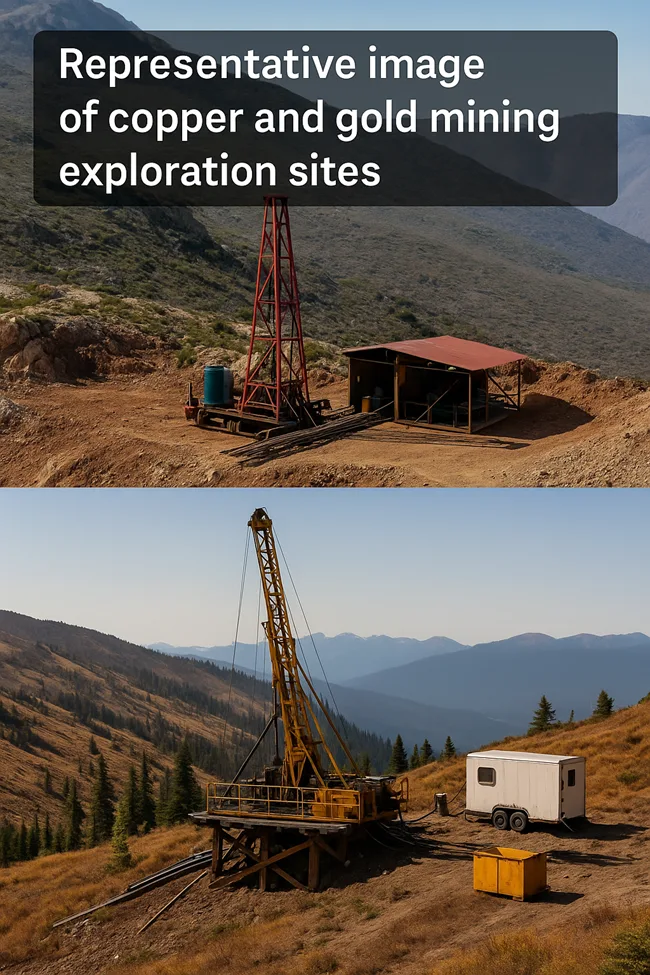




Australian gold explorer Desert Metals Limited (ASX:DM1) has commenced a +5,000m diamond drilling program at the King Kong prospect, located within its highly prospective Adzope gold project in southern Côte d’Ivoire. This initiative marks the company’s second major drill campaign at the site and is designed to test and expand known high-grade mineralisation across a 1.4km corridor previously defined by significant gold intercepts.
The King Kong prospect lies in the northeastern section of Adzope, where past drilling and multiple layers of geophysical and geochemical data have outlined coincident anomalies. Desert Metals is deploying a staged approach, starting with 2,200m of initial drilling across 18 diamond holes, targeting the structural corridor that includes past intercepts of 17m at 7.5g/t gold in the south and 13m at 1.64g/t gold in the north. Assays from this phase are expected during the September 2025 quarter.
The broader program is expected to span 12 weeks and represents the most extensive testing of this mineralised trend to date.
Why is the King Kong gold corridor seen as a high-priority drill target in Desert Metals’ 2025 strategy?
Desert Metals has made the King Kong prospect a focal point of its exploration agenda due to its high-potential gold corridor, identified through a confluence of dipole-dipole geophysics, surface magnetics, induced polarisation, and soil geochemistry. Notably, this is the first time the entire 1.4km corridor, along with a 400m extension, is being systematically drill-tested. The company believes this belt hosts structurally controlled mineralisation linked to previous high-grade hits, making it a priority for delineating a maiden resource.
The Adzope permit, where King Kong is located, is in southern Côte d’Ivoire—a jurisdiction that has drawn increasing interest from Australian and Canadian juniors due to its relatively underexplored Birimian greenstone belts and improving political stability. Desert Metals has interpreted the King Kong trend as an orogenic-style gold system, which is often associated with large, continuous deposits in West Africa.
From a technical standpoint, the decision to begin with triple-tube diamond drilling is also important. This method ensures better core recovery in oxide zones, which are notoriously difficult to sample but may hold significant near-surface gold grades. Desert Metals’ ability to dynamically adjust drillhole locations based on real-time core observations provides operational agility in unlocking structurally complex systems.
How are institutional investors viewing the use of drill-for-equity and portable rigs in this campaign?
Institutional sentiment around Desert Metals’ cost management strategy appears cautiously optimistic. By executing a drill-for-equity agreement with a local contractor, Desert Metals can defer up to 50% of drilling costs via the issuance of shares, calculated on a rolling ten-day VWAP. This mechanism allows the gold exploration developer to extend its campaign without immediate cash outlay—preserving working capital while maintaining drilling momentum.
Investors have also responded favorably to the operational efficiency of the Rock-800 diamond drill rig, which requires minimal infrastructure and enables mobility between targets. The decision to again use this rig, proven in earlier campaigns, underlines Desert Metals’ intent to keep the environmental footprint and site compensation obligations low—an important factor in West African jurisdictions where ESG compliance increasingly impacts asset valuation.
Although analysts have not issued public upgrades based on this drilling announcement alone, there is growing belief that Desert Metals’ ability to generate consistent news flow over the September quarter could support improved market visibility, especially if assays confirm continuity of high-grade mineralisation.
What are the strategic implications of Desert Metals’ gold-focused expansion in Côte d’Ivoire?
This drilling campaign highlights Desert Metals’ continued pivot toward West African gold, which now anchors its broader growth narrative. In addition to Adzope, Desert Metals owns 51% of the Tengrela South project—strategically located near the producing Sissingué gold mine—and is earning up to 80% interest in multiple high-potential Côte d’Ivoire tenements.
These assets, covering 1,074km² of prospective ground, place Desert Metals among a rising class of ASX-listed junior explorers betting on the next wave of African gold discoveries. With infrastructure such as processing hubs and road access improving across the region, the current strategy appears aligned with mid-tier acquisition trends seen across the continent.
The Côte d’Ivoire government has also been proactive in reforming mining laws and offering stability assurances, which is likely to strengthen the case for future farm-ins or offtake agreements should Desert Metals define a viable resource at King Kong or its surrounding zones.
What are the next steps for Desert Metals and when will assay results be available?
The first stage of drilling is scheduled to take four to five weeks, with final drillhole locations to be refined as core observations and early assays inform program evolution. Desert Metals will use the Chrysos PhotonAssay technique at Intertek Ghana for assay processing—a method known for its rapid turnaround and bulk gold analysis capabilities. Results from the first three holes could help shape the direction of the remainder of the +5,000m campaign.
Beyond the current program, the gold exploration company has left open the option to expand drilling based on positive results. A successful campaign could ultimately lead to a defined maiden resource for King Kong in 2026, positioning Desert Metals as a more prominent player in the West African gold narrative.
If mineralisation proves continuous across the full 1.4km corridor and shows depth persistence, the likelihood of resource modeling will increase sharply. In that case, Desert Metals may either accelerate development planning or attract interest from larger gold producers seeking entry or consolidation opportunities in Côte d’Ivoire.
Could Desert Metals be setting itself up for a re-rating in the 2025–2026 investment cycle?
Desert Metals’ ability to blend exploration success with prudent cost management may appeal to value-focused investors looking for gold upside in a diversified geopolitical setting. While short-term performance will hinge on assay results due in the September quarter, a strong technical hit rate—especially between known intercepts—could drive renewed institutional interest.
The drill-for-equity agreement lowers upfront risk, and the use of low-impact rigs adds ESG appeal. If assays confirm grade continuity or reveal new structural complexity with economic implications, the gold exploration developer may command a premium compared to peers operating in more mature jurisdictions. Ultimately, Desert Metals’ King Kong campaign could be a defining chapter in its Côte d’Ivoire strategy, setting the stage for more aggressive development or joint venture structuring by mid-2026.
Discover more from Business-News-Today.com
Subscribe to get the latest posts sent to your email.