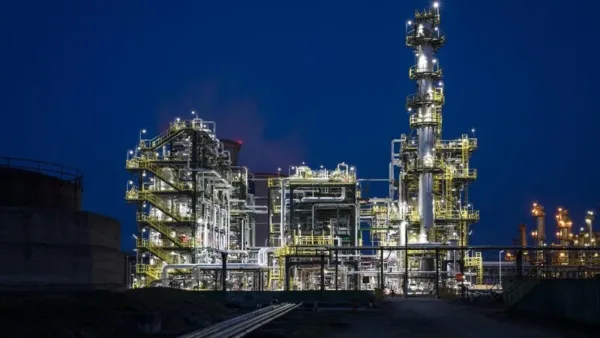


Caturus has signed a 20-year liquefied natural gas sale and purchase agreement with Aramco Trading Americas LLC covering 1 million tonnes per annum of LNG from the Commonwealth LNG export facility under development in Cameron Parish, Louisiana. The agreement strengthens Commonwealth LNG’s contracted capacity base as the project advances toward a final investment decision (FID) planned for the first quarter of 2026. Strategically, the deal reinforces long-term demand for U.S. LNG while anchoring Caturus’s wellhead-to-water integration strategy with another globally diversified counterparty.
Why Aramco Trading Americas LLC committing to a 20-year LNG offtake matters for Caturus right now
The significance of the Aramco Trading agreement lies less in the volume alone and more in its timing. Commonwealth LNG is approaching a critical transition point from development to sanction, where project credibility depends on long-dated, bankable offtake contracts rather than aspirational market demand. A 20-year commitment from a trading arm linked to Saudi Aramco adds durability to the revenue stack at precisely the stage lenders, equity partners, and contractors scrutinize most closely.
For Caturus, this contract reinforces a deliberate sequencing strategy. Over the past year, the company has prioritized long-term offtake alignment before finalizing financing and construction mobilization. By locking in another million tonnes per annum with a counterparty that has both global trading reach and balance sheet strength, Caturus reduces residual commercial risk ahead of final investment decision approval.
The agreement also diversifies Commonwealth LNG’s customer mix geographically and strategically. Rather than concentrating exposure in a single region or buyer profile, Caturus continues to assemble a portfolio spanning commodity traders, national energy companies, and utility-linked buyers. This mix enhances optionality across pricing indices, destination flexibility, and downstream market access.

How this deal advances Commonwealth LNG’s final investment decision readiness
Commonwealth LNG is permitted for 9.5 million tonnes per annum of liquefaction capacity, with Phase 1 expected to generate approximately $3.5 billion in annual export revenue once operational around 2030. With the Aramco Trading contract added, the project has now secured long-term offtake agreements covering the majority of its permitted capacity, joining earlier commitments from Glencore, JERA, PETRONAS, Mercuria, and EQT.
From a financing perspective, this level of contracted volume materially strengthens debt underwriting assumptions. Long-term SPAs underpin predictable cash flows, which in turn support higher leverage tolerance and potentially more competitive financing terms. For a capital-intensive LNG project, that translates directly into improved equity returns and reduced cost-of-capital sensitivity.
The timing also aligns with Caturus’s decision in late 2025 to authorize full purchase orders for long-lead equipment through its engineering, procurement, and construction partner Technip Energies. Those orders, including compressors, cryogenic heat exchangers, and turbine generators, signal confidence that commercial and financial conditions are converging rather than diverging.
What Aramco Trading gains from locking in U.S. Gulf Coast LNG supply
For Aramco Trading Americas LLC, the agreement reflects a pragmatic expansion of its LNG portfolio rather than a symbolic entry into U.S. gas. Securing long-term LNG volumes from the U.S. Gulf Coast offers geographic diversification away from legacy supply regions while providing access to Henry Hub-linked pricing structures that can hedge exposure to oil-indexed contracts elsewhere.
The deal also strengthens Aramco Trading’s role as a global intermediary rather than a purely upstream-linked supplier. By adding U.S. LNG to its portfolio, the trading arm enhances its ability to serve a broader customer base across Asia, Europe, and emerging markets, particularly in periods of regional supply stress.
From a strategic standpoint, the agreement underscores how Middle Eastern energy groups are positioning LNG not as a transitional afterthought but as a structural component of long-term energy security planning. While Saudi Aramco’s core production remains oil-centric, its trading affiliates are increasingly active in gas and LNG markets where flexibility and optionality matter more than ownership of molecules.
How Caturus’s wellhead-to-water model differentiates it in the U.S. LNG project landscape
Caturus has consistently framed Commonwealth LNG as part of an integrated platform rather than a standalone export terminal. The company’s upstream operations, inherited from its former Kimmeridge Texas Gas assets, provide direct access to gas supply across approximately 250,000 net acres in Texas with production exceeding 600 million cubic feet equivalent per day.
This upstream linkage offers two strategic advantages. First, it reduces exposure to third-party supply volatility during periods of pipeline congestion or price dislocation. Second, it strengthens the environmental and emissions narrative increasingly demanded by long-term LNG buyers, particularly in Europe and parts of Asia, where provenance and methane intensity are becoming contractual considerations rather than marketing claims.
The modular construction approach adopted for Commonwealth LNG further reinforces this differentiation. By shifting millions of labor hours into fabrication yards rather than on-site construction, Caturus aims to control schedule risk in a region where labor competition has historically undermined cost certainty for LNG projects.
How Caturus’s expanding offtake book reshapes the competitive race among U.S. Gulf Coast LNG projects seeking FID
The steady accumulation of long-term offtake contracts at Commonwealth LNG sends a clear signal to competing U.S. projects still struggling to convert interest into binding commitments. In an increasingly crowded Gulf Coast LNG market, the ability to demonstrate credible customer backing is becoming the primary gating factor for sanction, not regulatory approval.
Projects that rely heavily on short-term or portfolio-based sales may find financing conditions tightening as lenders favor assets with visible, contracted revenue streams. Caturus’s approach contrasts with developers betting on spot market exposure or post-FID marketing, which may face higher capital costs or delayed timelines.
At an industry level, the agreement reinforces the idea that the next wave of U.S. LNG projects will be defined by commercial discipline rather than speculative capacity buildout. Buyers are willing to sign 20-year contracts, but only with projects that demonstrate execution readiness and balance-sheet resilience.
Which execution risks still matter for Commonwealth LNG even as long-term offtake commitments continue to grow
While the Aramco Trading agreement materially improves Commonwealth LNG’s outlook, it does not eliminate execution risk. Final investment decision approval remains contingent on completing the financing package and satisfying customary conditions embedded in the SPAs.
Construction risk also remains nontrivial. Even with modularization, large-scale LNG projects face exposure to supply chain delays, contractor performance issues, and cost inflation. The Gulf Coast remains a competitive environment for skilled labor, logistics capacity, and specialized equipment.
Regulatory and policy risks, while lower for permitted projects like Commonwealth LNG, cannot be dismissed entirely. Shifts in U.S. export policy, environmental scrutiny, or permitting processes at the federal level could still influence project economics over a multi-decade operating horizon.
What this agreement signals about long-term LNG demand and global gas flows
The willingness of major trading houses and national energy affiliates to commit to 20-year LNG contracts challenges narratives that long-term gas demand is structurally incompatible with energy transition goals. Instead, the market appears to be pricing LNG as a stabilizing asset in a volatile global energy system rather than a temporary bridge fuel.
For the United States, deals like this reinforce its role as a cornerstone supplier of flexible LNG volumes into global markets. The combination of scale, pricing transparency, and geopolitical neutrality continues to resonate with buyers seeking to diversify away from single-source dependence.
From a strategic lens, the Caturus-Aramco Trading agreement underscores how LNG has become a tool of energy security, portfolio optimization, and geopolitical risk management rather than merely a commodity transaction.
Key takeaways on what the Caturus–Aramco Trading LNG agreement means for investors and the LNG sector
- The 20-year SPA with Aramco Trading Americas LLC materially strengthens Commonwealth LNG’s path to final investment decision approval in early 2026.
- Long-term offtake coverage now supports the majority of Commonwealth LNG’s 9.5 Mtpa permitted capacity, improving financing visibility.
- The agreement enhances Caturus’s commercial credibility by adding another globally diversified, balance-sheet-strong counterparty.
- Aramco Trading gains long-dated exposure to U.S. Gulf Coast LNG, diversifying supply sources and pricing structures.
- The deal reinforces U.S. LNG’s role as a cornerstone of global energy security rather than a short-term transition asset.
- Caturus’s integrated wellhead-to-water model reduces supply and emissions risk relative to standalone export projects.
- Modular construction and early equipment procurement signal execution confidence but do not eliminate construction and cost risks.
- Competing U.S. LNG projects without contracted offtake may face rising financing hurdles as lenders prioritize certainty.
- The agreement highlights a broader industry shift toward disciplined, contract-backed LNG capacity rather than speculative buildout.
Discover more from Business-News-Today.com
Subscribe to get the latest posts sent to your email.