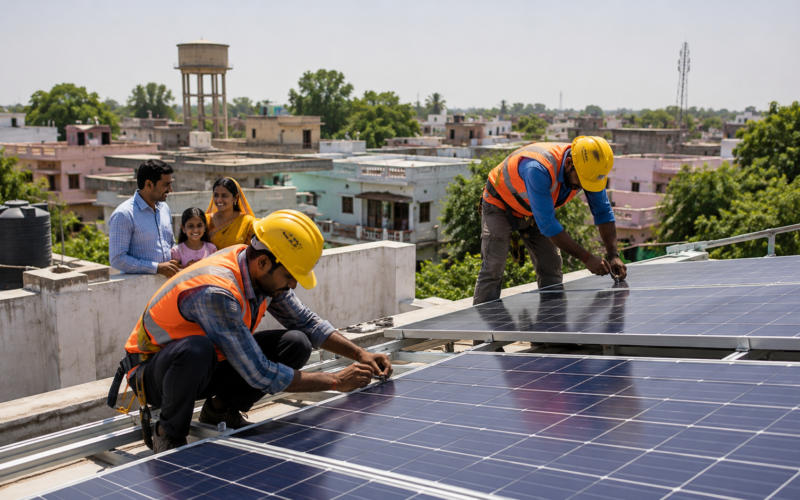
The World Bank has approved $890 million in financing to accelerate India’s PM Surya Ghar: Muft Bijli Yojana rooftop solar programme, giving the country’s residential solar push a major multilateral funding boost. The package is designed to support solar rooftop installations across rural and urban households while mobilising commercial loans that can reduce the upfront burden on consumers. The financing is strategically important because India’s large-scale solar capacity has expanded rapidly, but residential rooftop adoption still depends on bank lending, distribution-company cooperation, vendor capacity and consumer trust. The approval turns rooftop solar into a sharper infrastructure-finance story, where the next test is not whether India wants more clean power, but whether the system can deliver millions of small projects without drowning in paperwork.
Why does the World Bank’s $890 million financing package matter for India’s rooftop solar programme?
The World Bank’s $890 million financing package matters because India’s rooftop solar challenge is no longer mainly about policy intent. The country has already created a national programme, offered subsidies and set a target of reaching 10 million households. The harder problem is converting household interest into completed installations, and that requires accessible credit, trained vendors, efficient distribution-company approvals and a financing model that works for ordinary consumers rather than only early adopters.
The financing package directly targets that gap. It includes $820 million from the International Bank for Reconstruction and Development, a $60 million concessional loan from the Clean Technology Fund and a $10 million grant from the Livable Planet Fund. More importantly, the World Bank expects the package to help mobilise $4.2 billion in private financing through commercial loans. That private-capital multiplier is the strategic heart of the announcement because India cannot scale residential solar to millions of homes through subsidies alone.
For the Government of India, the approval strengthens the financial architecture behind PM Surya Ghar: Muft Bijli Yojana. The programme already offers incentives to households, but adoption depends heavily on whether banks are willing to lend quickly and whether consumers believe the installation process is reliable. The World Bank package gives the programme more credibility with lenders and distribution companies, but it also raises expectations. Once concessional capital enters the system, execution excuses become thinner.
How could PM Surya Ghar financing change the economics of residential rooftop solar in India?
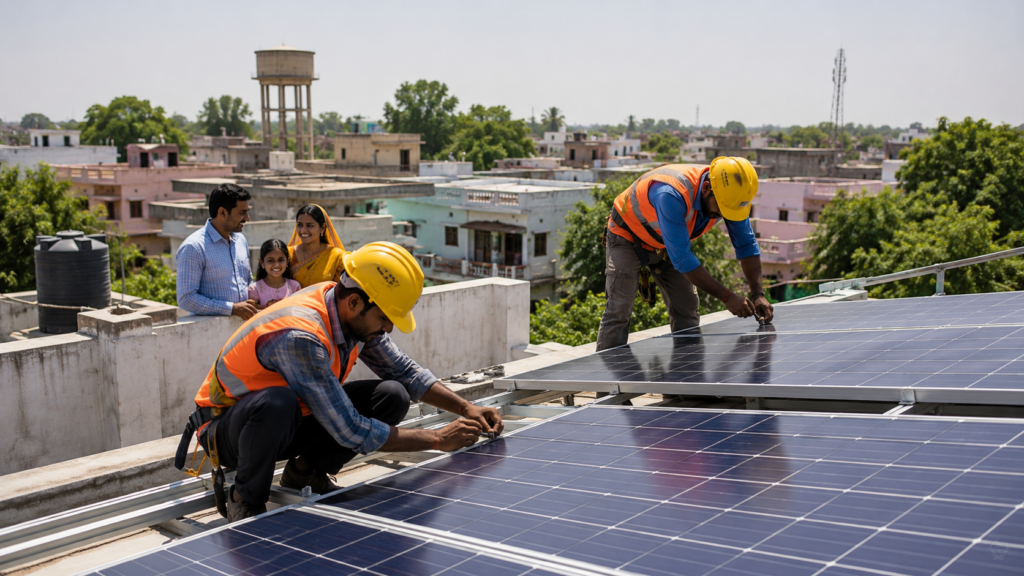
The biggest economic barrier in residential rooftop solar is the upfront cost. Even when a household expects lower electricity bills over time, the initial investment can be difficult to absorb. Subsidies reduce that burden, but many consumers still require loans or vendor-backed financing before they can proceed. The new financing package is therefore important because it is designed to make commercial credit more available to households that may not have easy access to low-cost clean-energy loans.
The use of collateral-free financing is especially relevant for mass-market adoption. If households are forced into complicated documentation, collateral demands or delayed bank approvals, rooftop solar remains a middle-class or upper-income convenience rather than a national infrastructure programme. A smoother credit channel can expand adoption beyond consumers who can pay upfront, which is essential if the 10 million-household target is to become more than a headline number.
The risk is that cheaper or more available credit does not automatically solve execution. Residential rooftop solar is fragmented by nature. Every roof is different, every distribution-company process can vary, and every household has its own consumption pattern, repayment profile and trust threshold. Financing can open the door, but the installation ecosystem still has to walk through it with panels, inverters, net-metering approvals and customer service that does not make consumers regret answering the phone.
Why is private capital mobilisation the real test behind India’s rooftop solar expansion?
The expected mobilisation of $4.2 billion in private financing is the most important number in the announcement because it shows that the public funding is intended to crowd in lenders rather than replace them. India’s clean-energy ambitions are too large for multilateral and government funding to carry on their own. Rooftop solar, in particular, requires a distributed lending market where banks, non-bank financial companies and vendors can serve millions of relatively small customers.
That makes risk perception central. Banks need confidence that rooftop solar loans can be originated, verified, monitored and recovered without excessive administrative costs. They also need clarity on subsidy flows, net-metering rules, consumer payment behaviour and equipment quality. If those pieces remain uneven, lenders may treat rooftop solar as a niche product despite the policy push. The World Bank’s role is therefore partly financial and partly catalytic: it is trying to make the asset class look less risky to private lenders.
The competitive implication is that financial institutions that build scalable rooftop solar lending products early could gain a durable position in India’s distributed energy market. This is not just about one loan programme. It is about creating a consumer-finance category around household electricity assets. If the model works, banks could later finance batteries, electric vehicle charging, energy-efficient appliances and other distributed energy products. Rooftop solar may be the first product in a much larger household energy-finance stack.
How will distribution companies shape the success or failure of India’s residential solar push?
Distribution companies remain one of the most important execution variables in India’s rooftop solar market. A household can receive a subsidy, secure a loan and choose a vendor, but the project still depends on grid connection, metering, inspection and billing integration. If distribution-company processes are slow or inconsistent, residential solar adoption can stall even when demand and financing are available.
This matters because distribution companies face mixed incentives. Rooftop solar can reduce peak pressure, improve local clean-energy generation and support national targets. However, it can also reduce electricity sales to higher-paying residential consumers in some tariff structures, especially if net metering shifts cost recovery concerns onto the utility. That tension is not unique to India, but it becomes more serious when the target is 10 million households.
The financing package recognises this by supporting distribution-company capacity along with household finance. That is critical because PM Surya Ghar: Muft Bijli Yojana cannot function as a pure consumer subsidy scheme. It must operate as a coordinated system across utilities, lenders, vendors and government platforms. If distribution companies are treated as passive back-office processors, bottlenecks will multiply. If they are given incentives, digital tools and operational support, they can become accelerators rather than speed breakers.
What does the World Bank approval mean for India’s domestic solar manufacturing and services chain?
The financing package could support India’s solar manufacturing and services ecosystem by creating more predictable residential demand. Utility-scale solar has already driven large procurement volumes, but rooftop solar has a different industrial profile. It requires installers, electricians, sales networks, maintenance providers, financing agents, digital platforms, customer-service teams and local distribution-company coordination. That makes the employment and services impact broader than a large solar park with a concentrated construction schedule.
The World Bank expects the programme to create 1.7 million job opportunities across renewable energy manufacturing, installation and services. The scale of that number depends on actual deployment, domestic supply participation and the durability of installation activity. If the programme accelerates smoothly, it could support a large distributed workforce across states, including smaller contractors and local vendors. If deployment is uneven, job creation may remain concentrated in stronger states with better utility coordination and consumer awareness.
There is also a quality-control risk. A rapid rooftop solar boom can attract weak vendors, inconsistent installation practices and equipment-quality problems. That can damage consumer trust quickly because rooftop solar is installed directly on homes, not hidden inside remote utility sites. For India’s solar services chain, the opportunity is large, but so is the need for standardisation, certification, warranties and after-sales support. A bad inverter experience can undo a lot of clean-energy enthusiasm at the neighbourhood level.
Why does rooftop solar matter when India already has large-scale renewable energy capacity?
Rooftop solar matters because it addresses a different part of the power-system problem than utility-scale renewable energy. Large solar parks can add capacity quickly, but they require land, transmission infrastructure, grid planning and often long-distance power movement. Rooftop solar produces electricity closer to where it is consumed, which can reduce some distribution-level pressure and give households direct participation in the energy transition.
Residential rooftop solar also changes consumer behaviour. When households become power producers, even at a small scale, electricity becomes more visible as a financial and infrastructure asset. That can support demand for smarter meters, efficient appliances, batteries and time-of-use pricing over time. The policy value is not just megawatts installed. It is the creation of a more active electricity consumer base.
The limitation is that rooftop solar cannot replace the need for transmission, grid-scale renewables, storage or flexible generation. Household generation is intermittent, roof suitability varies, and distribution systems still need to manage two-way power flows. The best policy reading is therefore balanced: rooftop solar is not a magic trick, but it is a powerful tool if integrated with utility planning, storage deployment and realistic tariff design. The sun may be free, but the grid accountant is not.
What are the main execution risks that could slow PM Surya Ghar despite new financing?
The first execution risk is lending friction. If banks remain cautious, impose unnecessary collateral conditions, delay approvals or struggle with documentation, consumers may drop out before installation. Residential solar is a high-volume, low-ticket market compared with large infrastructure lending, which means processing efficiency matters enormously. A slow loan journey can kill consumer intent faster than a cloudy monsoon week.
The second risk is state-level inconsistency. India’s power sector is nationally ambitious but locally executed. Net-metering rules, distribution-company readiness, vendor ecosystems, subsidy processing and consumer awareness can vary sharply by state. Stronger states may accelerate installations while weaker states lag, creating uneven progress beneath a national target. That matters because the programme’s headline goal depends on scale across both urban and rural households.
The third risk is cost inflation and equipment availability. Solar module prices have been more stable than battery costs in recent periods, but distributed solar economics can still be affected by component prices, inverter supply, labour costs, financing rates and currency movements. If installed costs rise or vendor margins tighten, households may need more support or longer payback periods. The policy design must be flexible enough to respond without turning every cost adjustment into a bureaucratic wrestling match.
How could this financing affect India’s broader electricity market and clean-power targets?
The financing supports India’s broader clean-power strategy by accelerating distributed solar in a system where electricity demand continues to rise. India has committed to reaching net zero by 2070 and increasing non-fossil-fuel-based energy resources to 60% of its electricity mix by 2035. Rooftop solar can contribute to that target while also reducing household electricity bills, improving consumer participation and lowering demand pressure in some parts of the distribution network.
At scale, rooftop solar can alter utility revenue models. Distribution companies may need to rethink tariff design, fixed charges, grid service compensation and the value of distributed generation. That is not a reason to resist rooftop solar, but it is a reason to design carefully. A successful residential solar market must protect consumers who adopt solar while also ensuring that non-solar customers are not unfairly loaded with grid costs.
The programme may also increase pressure to accelerate storage and demand-response adoption. As more households install rooftop solar, midday generation and evening demand patterns become more important. Without storage or flexible demand, solar-heavy distribution circuits may face operational challenges. In that sense, PM Surya Ghar could become the opening chapter of a wider distributed energy market that eventually includes batteries, smart meters, electric vehicle charging and local grid services.
Why could the World Bank-backed model become a template for emerging-market solar finance?
The World Bank-backed model could become relevant beyond India because many emerging markets face a similar rooftop solar dilemma. Residential solar has strong long-term economics in sunny countries, but adoption can be limited by consumer credit, weak utility processes, poor vendor quality and fragmented regulation. A blended finance structure that reduces lender risk and builds institutional capacity could help turn rooftop solar from an elite product into a mainstream infrastructure category.
India is a particularly important test case because of its scale. If the country can build a functioning model for millions of household installations, other markets will study the combination of subsidy design, commercial lending, distribution-company incentives and digital application systems. If India struggles despite large funding support, it will show that financing alone cannot overcome weak execution architecture.
The lesson for development finance is also important. Clean-energy lending is moving beyond large generation projects into distributed assets that require different risk tools. Financing a solar park is one kind of infrastructure banking. Financing millions of rooftops is closer to building a national clean-energy consumer-credit platform. That is messier, but potentially more transformative because it moves the energy transition directly into households.
What are the key takeaways from the World Bank’s $890 million India rooftop solar financing?
- The World Bank’s $890 million approval is a confirmed financing package for India’s PM Surya Ghar: Muft Bijli Yojana, not a proposed policy idea.
- The package includes $820 million from the International Bank for Reconstruction and Development, $60 million from the Clean Technology Fund and a $10 million Livable Planet Fund grant.
- The larger strategic goal is to mobilise $4.2 billion in private commercial loans for household rooftop solar installations.
- The financing targets one of India’s biggest clean-energy bottlenecks: affordable consumer credit for residential rooftop solar.
- Distribution companies remain critical because approvals, metering, billing integration and grid connection can still slow deployment.
- The programme’s 10 million-household target depends on bank participation, vendor quality, state-level coordination and consumer confidence.
- Domestic solar manufacturing, installation and services providers could benefit if demand becomes predictable and execution standards are enforced.
- Rooftop solar supports India’s non-fossil electricity targets but must be integrated with grid planning, storage and tariff reform.
- The main risks are slow lending, uneven state execution, weak vendor quality, rising component costs and distribution-company resistance.
- The expert assessment is that the World Bank financing improves the probability of scale, but India’s rooftop solar success will be decided by implementation quality rather than funding headlines.
Share this:
Discover more from Business-News-Today.com
Subscribe to get the latest posts sent to your email.