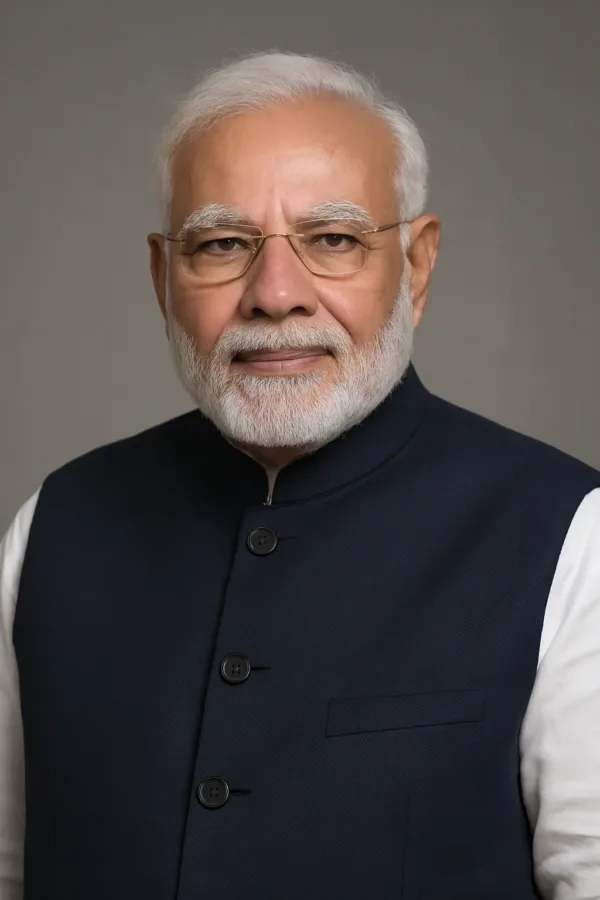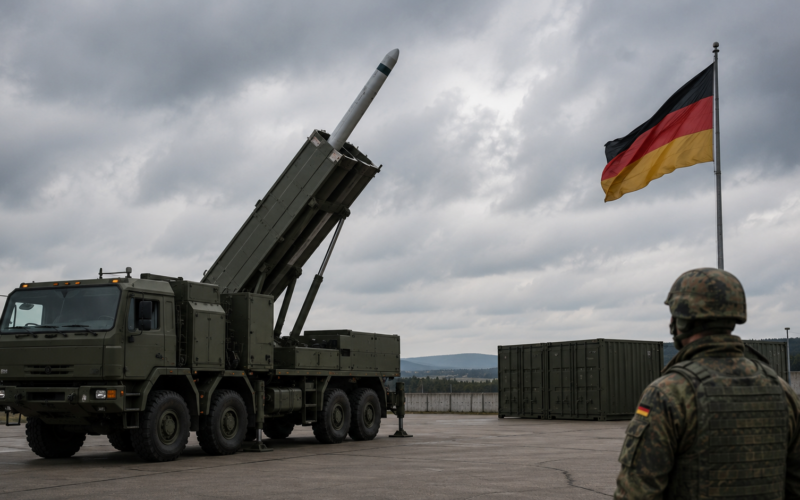
Germany will buy United States Tomahawk cruise missiles and station them on German soil, Chancellor Friedrich Merz said on July 9, 2026, in one of Berlin’s most significant long range weapons decisions since Russia’s full scale invasion of Ukraine reshaped European security.
Merz told German lawmakers that the agreement was reached with the United States government on the sidelines of the NATO summit in Ankara. German government sources said Washington committed in a letter of intent to approve Germany’s procurement of Tomahawk missiles and corresponding ground based Typhon launchers in August, though the number of missiles and launchers remains classified.
The decision replaces uncertainty over earlier plans for a United States battalion equipped with long range missiles to be deployed in Germany. Donald Trump’s decision in May to reduce the United States military presence in Germany had cast doubt on that arrangement, pushing Berlin towards owning the capability rather than depending on an American deployment.
The purchase also gives Merz a powerful response to NATO’s demand that European allies take more responsibility for their own security. Germany is not only buying a weapon. It is accepting that deterrence against Russia now requires European governments to control, fund and host strike systems that can reach deep into hostile territory.
Why is Germany buying Tomahawk missiles from the United States now?
Germany’s decision reflects a strategic gap that Berlin no longer wants to leave to United States forces alone. Merz told lawmakers that the purchase would close a critical gap in Germany’s defence while Europe develops and stations its own future systems.
That gap is range. Germany already produces the Taurus cruise missile, but the Taurus has a range of about 500 kilometres. The Tomahawk’s range is about 1,600 kilometres, giving it the ability to hit targets far deeper inside hostile territory and forcing an adversary to think differently about command centres, logistics hubs, air bases and missile launch sites.
The timing is also driven by doubts over United States military permanence in Europe. Washington remains NATO’s most powerful military actor, but Trump’s signalling on troop reductions has made European governments less comfortable relying on American deployments for every major deterrent capability.
Germany’s response is to buy the capability directly. That does not sever reliance on the United States because the Tomahawk is an American system and requires United States approval, technology support and supply chains. But it gives Berlin more direct ownership over deployment planning, procurement and integration into German defence strategy.
The deal also fits Washington’s pressure campaign. Trump has repeatedly demanded that European allies pay more for their own defence and buy more United States weapons. From that perspective, the Tomahawk agreement allows Germany to show burden sharing while giving American defence suppliers a major European order.
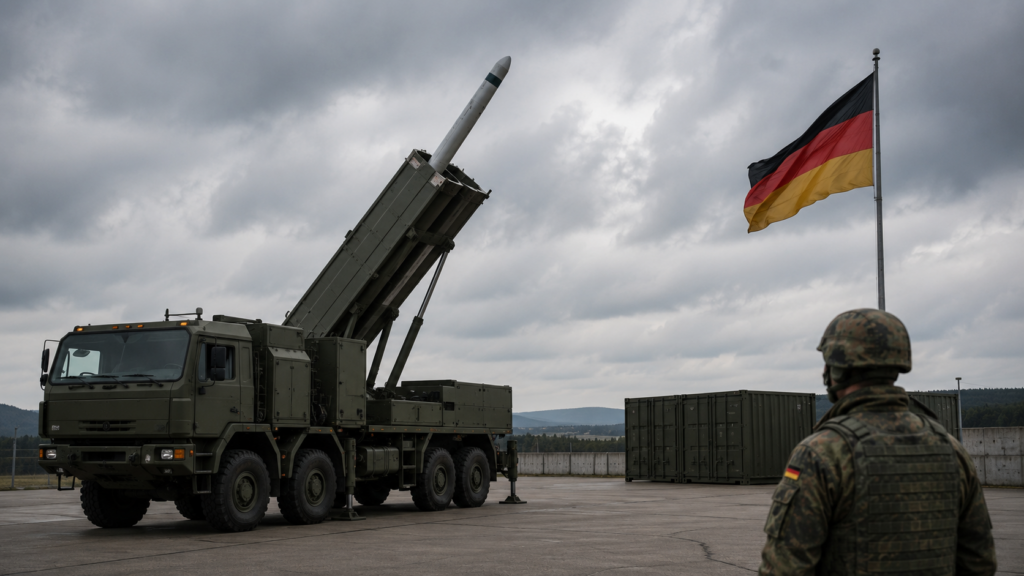
What does the Tomahawk deal change in Germany’s military posture?
The Tomahawk purchase moves Germany closer to possessing a credible land based long range strike capability. That is a major change for a country that has spent decades exercising caution around offensive military power because of its 20th century history.
Long range strike is different from air defence or armoured mobility. It is designed to threaten targets far beyond the immediate battlefield, including command nodes, missile batteries, airfields, logistics centres and infrastructure supporting enemy operations.
This matters because deterrence works partly through the threat of retaliation. If Russia knows that Germany can strike high value targets at long range, Moscow must factor that risk into any future escalation involving NATO territory.
The decision also strengthens Germany’s role inside NATO. Berlin has often been criticised for slow defence modernisation, procurement delays and reluctance to move as quickly as eastern European allies wanted after Russia invaded Ukraine. Buying Tomahawks gives Merz a concrete answer to those criticisms.
However, possession of the missiles is only one part of the capability. Germany will need training, command arrangements, targeting doctrine, storage facilities, security procedures, communications systems and clear political decision making on when such weapons could be used.
The question is not only whether Germany can buy Tomahawks. It is whether Berlin can integrate them into a credible deterrence posture without creating confusion over command authority, escalation thresholds or coordination with NATO allies.
Why does the shift from United States deployment to German ownership matter?
The earlier plan involved a United States battalion equipped with Tomahawk missiles operating from Germany as an interim deterrent while Europe developed its own systems. That arrangement would have given NATO long range strike presence on German soil, but operational control would have remained strongly tied to the United States.
The new model is different. Germany is buying the missiles and launchers itself. Associated Press reported that deployment of United States personnel to operate the systems was not part of the letter of intent underpinning the agreement.
That matters politically because it shifts responsibility towards Berlin. Germany cannot simply say it hosts allied capability. It will have to explain why it owns the missiles, how they fit into national defence and how their use would be governed.
The change also reflects a wider European security transition. The United States is still indispensable to NATO, but European governments are being pushed to own more capability directly. That applies to air defence, ammunition, drones, cyber resilience, munitions production and now long range strike.
For Germany, the shift strengthens sovereignty but increases accountability. If the missiles are deployed under German control, Berlin will need to make decisions that were previously easier to leave inside American command structures.
That may be strategically necessary, but it will also create a more intense domestic debate over deterrence, escalation and Germany’s military identity.
How do Tomahawks compare with Germany’s existing Taurus missiles?
Germany’s Taurus cruise missile is a capable weapon, but its range is far shorter than the Tomahawk. Reuters reported that Taurus has a range of about 500 kilometres, while AP placed Tomahawk’s range at about 1,600 kilometres.
That difference changes the geography of deterrence. A 500 kilometre missile can threaten targets in the operational rear. A 1,600 kilometre missile can reach much deeper, depending on launch location and route.
The Tomahawk also has a long operational history. It has been used by the United States military since the 1980s and is known for precision strike against targets deep inside defended territory. AP noted that it flies low, around 100 feet above the ground, making it harder for air defence systems to detect.
For Germany, the Tomahawk is not a replacement for Taurus so much as an additional layer. Taurus remains part of Germany’s existing capability. Tomahawk adds reach, scale and a direct link to United States systems and doctrine.
That also raises procurement questions. Germany will need to manage how Tomahawk fits with Taurus, future European systems and NATO’s wider long range strike planning. Buying several overlapping capabilities can improve resilience, but it can also create integration complexity and higher maintenance costs.
The long term goal appears to be a bridge strategy: buy proven American systems now while continuing to develop European alternatives that reduce dependence over time.
Why will Russia see the German Tomahawk deal as a serious escalation signal?
Russia is likely to treat the Tomahawk decision as evidence that NATO is expanding strike capability near its borders. Moscow has repeatedly warned against Western long range weapons deployments in Europe, especially when they can threaten targets inside Russia.
From NATO’s perspective, the move is defensive deterrence. Germany is responding to Russia’s war against Ukraine, Russian missile threats, the collapse of old arms control arrangements and Moscow’s willingness to use force to change borders.
From Russia’s perspective, land based Tomahawks stationed in Germany create a potential strike threat that can reach deep into Russian territory. That will almost certainly become part of Russian military messaging, propaganda and potential counter deployment planning.
The danger is an arms race dynamic. If Germany fields Tomahawks, Russia may respond with more missiles in Kaliningrad, Belarus or western Russia. NATO may then strengthen air defence and strike assets, reinforcing the cycle.
That risk does not mean Germany will reverse course. European governments increasingly believe that weakness creates more danger than deterrence. The political judgement in Berlin appears to be that credible long range capability is now necessary because Russia has already shown it is willing to use large scale force in Europe.
The practical test will be crisis management. Germany and NATO will need to ensure that new weapons strengthen deterrence without creating ambiguous deployment patterns or command structures that increase the risk of miscalculation.
How does this deal fit into NATO’s post-Ankara burden sharing push?
The Ankara summit has put pressure on European allies to prove that they can pay for and produce more of their own defence capability. Germany’s Tomahawk decision is exactly the kind of headline commitment that NATO leaders can present as evidence of European seriousness.
It also serves Trump’s preferred model of burden sharing. Rather than relying on the United States to station forces and equipment indefinitely, European allies buy high end American systems and assume more responsibility for their own deterrence.
For NATO, this is useful but incomplete. Buying Tomahawks strengthens one capability, but Europe still faces shortages in air defence, ammunition, artillery, drones, logistics, military mobility, cyber protection and command systems.
Germany also faces a delivery challenge. A letter of intent and August approval are early steps. The strategic impact will depend on contracts, delivery timelines, training schedules, launcher deployment, stockpile depth and integration with NATO planning.
The purchase could also influence other European states. If Germany normalises land based long range strike on European soil, countries such as Poland, Finland, the Netherlands and others may look for complementary systems or deeper participation in joint strike planning.
NATO’s European pillar is therefore becoming more capable but also more complex. More national ownership means more weapons, but it also requires greater coordination to prevent duplication, gaps and escalation confusion.
What domestic political debate could the Tomahawk purchase trigger in Germany?
Germany’s postwar political culture has traditionally been cautious about weapons that can be seen as offensive or escalatory. The Tomahawk decision will therefore attract scrutiny inside parliament, civil society and parts of the German public.
Supporters will argue that Russia’s invasion of Ukraine has ended the era in which Germany could rely mainly on diplomacy, commerce and limited military readiness. They will say deterrence requires the ability to impose costs on an aggressor before war reaches German territory.
Critics may argue that stationing long range strike missiles in Germany increases the country’s target profile and could make it a frontline state in any NATO Russia confrontation. They may also question the cost, the dependence on United States weapons and the lack of public detail about missile and launcher numbers.
Merz will likely frame the deal as responsible deterrence rather than militarisation. His argument is that Germany must close a strategic gap now while working with Europe to develop future systems.
The classified nature of the quantity will be understandable from a military standpoint, but it may complicate democratic debate. Lawmakers and voters will want enough information to judge costs, risks and doctrine, even if exact operational details remain secret.
Germany’s challenge is to build consensus for a more dangerous era without appearing to abandon the restraint that has shaped its modern foreign policy identity.
What should be watched next after Germany’s Tomahawk announcement?
The first milestone is United States approval in August. Without formal approval, the letter of intent remains a political commitment rather than a completed procurement pathway.
The second issue is the number of missiles and Typhon launchers Germany acquires. The figure remains classified, but procurement scale will determine whether the capability is symbolic, limited or operationally significant.
The third issue is delivery timing. Deterrence value depends on when the systems actually arrive, when German crews are trained and when the missiles can be integrated into NATO command structures.
The fourth issue is Russia’s response. Moscow may issue threats, announce counter deployments or use the decision to justify additional missile deployments near NATO territory.
The fifth issue is European system development. Merz said Germany would work to develop European systems and station them in Europe, making the Tomahawk purchase an interim step rather than the final destination.
The sixth issue is domestic debate. The Bundestag, German voters and coalition partners will test whether Merz can sustain support for a more assertive military posture.
Germany’s Tomahawk decision is therefore not just another weapons purchase. It is a signal that Berlin now sees long range strike as a national responsibility, not only an American shield placed on German soil.
What are the key takeaways from Germany’s Tomahawk missile deal?
- Germany will buy United States Tomahawk cruise missiles and station them on German soil, Chancellor Friedrich Merz told lawmakers on July 9, 2026, after the NATO summit in Ankara.
- Washington has committed to approving Germany’s procurement of Tomahawk missiles and corresponding ground based Typhon launchers in August, though the number of missiles and launchers remains classified.
- The purchase marks a shift from a planned United States battalion deployment in Germany towards German ownership of a long range strike capability.
- Donald Trump’s decision in May to reduce the United States military presence in Germany increased uncertainty over earlier deployment plans and pushed Berlin towards a more self reliant model.
- Tomahawk missiles offer a much longer reach than Germany’s Taurus cruise missile, with AP reporting a range of about 1,600 kilometres compared with Taurus at around 500 kilometres.
- The deal supports NATO’s wider burden sharing push by giving Germany a direct role in funding and controlling long range deterrence rather than relying solely on United States forces.
- Russia is likely to portray the deployment as escalation, while Germany and NATO will argue that the capability is a deterrent response to Moscow’s war against Ukraine and wider European security threats.
- The next major tests will be United States approval in August, contract details, delivery timelines, German crew training, NATO integration and domestic political acceptance inside Germany.
Share this:
Discover more from Business-News-Today.com
Subscribe to get the latest posts sent to your email.