


The FIFA World Cup 2026 is facing growing scrutiny over heat risk, hydration access and stadium safety rules as the expanded 48-team tournament prepares to stage 104 matches across the United States, Canada and Mexico during June and July, when several host cities can face high temperatures, humidity and strong sun exposure.
The immediate concern is not only the football schedule. It is the experience of hundreds of thousands of fans moving through stadiums, fan zones, transport hubs and outdoor gathering areas in North American summer conditions. FIFA has revised its stadium access position by allowing spectators at matches in the United States and Canada to bring one factory-sealed disposable soft plastic water bottle of up to 20 ounces, after earlier restrictions on reusable bottles drew criticism from fan groups and public figures.
The issue has become a wider public-interest test for FIFA World Cup 2026. The tournament will be the largest men’s World Cup ever staged, with more teams, more matches, more host cities and more travel than previous editions. That expansion creates commercial opportunity and wider global representation, but it also increases operational complexity. Heat safety, hydration access, shaded areas, cooling infrastructure, medical readiness and clear fan communication will now be central to how the tournament is judged off the pitch.
For players, heat can affect performance, recovery and match intensity. For spectators, heat can create health risks before, during and after matches, especially for children, older adults, people with medical conditions and fans spending long hours outdoors. The policy debate around water bottles is therefore not a minor stadium-entry issue. It sits inside a larger question about whether a summer mega-event across North America can balance security rules, commercial operations and public health needs.
Why has FIFA World Cup 2026 heat risk become a major public-safety issue before kickoff?
FIFA World Cup 2026 heat risk has become a major public-safety issue because the tournament will take place across multiple North American host cities during the hottest part of the year. June and July conditions can vary sharply between venues, but several host markets are known for high summer temperatures, humidity or intense sun exposure.
The scale of the tournament magnifies the concern. FIFA World Cup 2026 will feature 104 matches, compared with 64 matches in the previous 32-team structure. The larger match calendar means more fans moving through stadium perimeters, security checkpoints, transit routes, fan zones and outdoor entertainment areas over a longer period.
Heat risk is not limited to the 90 minutes of play. Fans often arrive hours before kickoff, queue at entrances, walk from transport points, spend time around food and beverage areas, and remain in crowded environments after the final whistle. Even if conditions inside some stadiums are managed, outdoor exposure around venues can still create health pressure.
The concern is especially relevant because FIFA World Cup 2026 is not being held in one compact climate zone. Matches will be staged in cities with very different summer profiles, including Atlanta, Dallas, Houston, Kansas City, Los Angeles, Miami, New York New Jersey, Philadelphia, Seattle, Toronto, Vancouver, Guadalajara, Mexico City and Monterrey. Each host city will require location-specific planning rather than one uniform heat-safety approach.
What changed in FIFA’s water bottle policy for World Cup 2026 spectators?
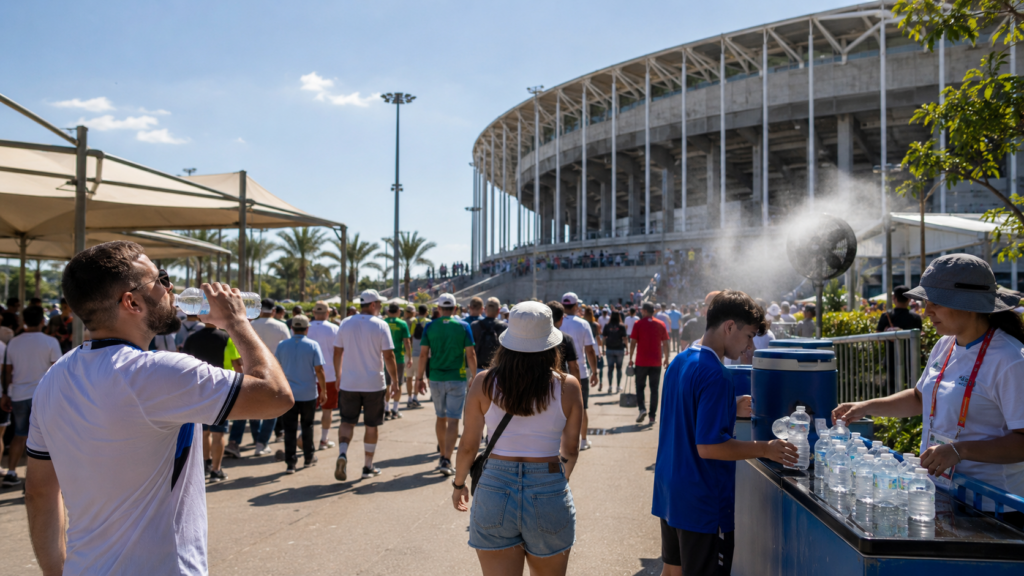
FIFA’s water bottle policy became controversial after restrictions on reusable bottles raised concerns about hydration access during hot-weather matches. FIFA has now moved to allow spectators at matches in the United States and Canada to bring one factory-sealed disposable soft plastic water bottle of up to 20 ounces into venues.
The updated position matters because it partially addresses concerns that fans could be left dependent only on stadium water sales or internal hydration points. A sealed bottle gives spectators at least one personal hydration option at entry, while still allowing organisers to maintain restrictions on harder containers that could be thrown or used unsafely.
The policy also shows the tension between security and public health. Stadium organisers routinely restrict objects that could become projectiles or safety hazards. At the same time, extreme heat or prolonged sun exposure can make water access an essential safety measure rather than a convenience.
The question for fans is whether one small sealed bottle is enough during long stadium visits in hot conditions. A 20-ounce bottle may help at entry, but spectators may still need quick access to refill points, affordable water, shaded waiting areas and clear signage. The effectiveness of the policy will depend on how smoothly hydration support works inside and around each venue.
How are host cities expected to manage hydration, cooling and crowd safety?
Host cities and tournament organisers are expected to use a mix of hydration stations, cooling areas, misting points, fans, medical support and crowd-management planning to reduce heat-related risks. These measures will be especially important in open-air venues and around stadium approaches where fans may wait or gather before entry.
Hydration stations are central because water access must be visible, reliable and easy to reach. If fans cannot find water points quickly, or if queues become too long, the practical value of the policy will weaken. Clear signage and multilingual communication will be important because FIFA World Cup 2026 will draw visitors from many countries.
Cooling infrastructure can also help reduce risk. Misting stations, shaded zones, cooling tents and rest areas can give fans temporary relief, particularly in cities where heat and humidity combine. These measures may be most important outside the stadium bowl, where spectators move through security zones, transportation corridors and fan gathering areas.
Medical readiness will matter as much as infrastructure. Heat-related illness can escalate quickly, especially in crowded areas. Host cities will need trained personnel, rapid response systems, clear emergency routes and coordination between stadium operators, public health officials, transport agencies and local emergency services.
Which FIFA World Cup 2026 venues and host markets could face closer heat scrutiny?
Several FIFA World Cup 2026 host markets are likely to face closer heat scrutiny because of summer weather patterns, stadium design and expected crowd volumes. Cities such as Dallas, Houston, Miami, Atlanta and Kansas City may attract attention because of high summer temperatures or humidity levels.
Some venues have climate-control advantages, while others are open-air or more exposed to outdoor conditions. Climate-controlled stadiums can reduce heat exposure for ticketed fans once they are inside the venue, but they do not fully solve the issue for queues, transit routes, fan zones and outdoor public events.
Open-air venues create different challenges. Fans may be exposed to direct sun, high temperatures and humid conditions depending on kickoff time and stadium design. Even evening matches can carry heat stress if temperatures remain elevated or if fans have spent hours outdoors before entering.
The host-city question is therefore broader than stadium architecture. A matchday heat plan must consider airport arrivals, public transport, walking routes, parking areas, security screening, food and beverage queues, fan festivals and post-match dispersal. The most effective plans will treat the entire matchday environment as the risk zone, not only the pitch and seats.
Why do hydration rules matter for both fans and players during FIFA World Cup 2026?
Hydration rules matter for fans because dehydration can develop quickly in hot conditions, particularly when people are walking, queuing, cheering, drinking alcohol or spending long periods in crowded areas. Even fans who are not directly in the sun may face risk if ventilation is poor or water access is limited.
For players, hydration and heat management affect performance and safety. High heat can reduce physical output, slow recovery and increase the risk of cramps, exhaustion or more serious heat-related illness. Mandatory hydration breaks and medical monitoring can help, but teams will still need to manage training intensity, warmups, travel and recovery carefully.
The difference between fans and players is support access. Players have medical staff, cooling tools, team protocols and controlled environments. Fans rely more heavily on stadium policy, public signage, water availability, shade, transport planning and personal preparation. That makes spectator safety especially dependent on event operations.
The expanded tournament format adds another layer. More matches mean more days of heat exposure risk. A team may be managed by sports science staff, but a travelling fan may attend multiple matches across different cities, each with different weather conditions and venue rules. Clear, consistent information will be essential.
How could heat and hydration concerns affect the wider fan experience at FIFA World Cup 2026?
Heat and hydration concerns could affect the wider fan experience by shaping how early spectators arrive, how long they remain around stadiums, whether they attend outdoor fan zones, and how they move between transport hubs and venues. If conditions are uncomfortable or confusing, the event experience can suffer even when the match itself runs smoothly.
Fan zones may become a particular area of concern. Large outdoor gatherings can attract supporters without stadium tickets, creating concentrated crowds in public spaces. These areas may need shade, water access, medical stations and real-time weather communication, especially during afternoon or early evening events.
Travel planning may also be affected. Fans may choose different clothing, carry fewer restricted items, arrive later to reduce outdoor waiting time, or avoid certain outdoor activities. Families with children and older supporters may need additional guidance on safe arrival times and hydration options.
The issue also affects trust. If fans believe the rules are unclear, inconsistent or commercially driven, frustration can grow. If fans see visible water access, cooling areas and staff guidance, confidence improves. For FIFA World Cup 2026, heat safety will be part of the tournament’s public reputation.
Why does FIFA World Cup 2026 raise bigger questions about climate and summer mega-events?
FIFA World Cup 2026 raises bigger questions about climate and summer mega-events because major international tournaments increasingly operate in conditions shaped by rising temperatures, changing weather patterns and higher public expectations around safety. Football’s global calendar remains tied to broadcast windows, host-country availability and tournament tradition, but heat exposure is becoming harder to treat as a secondary issue.
The challenge is not unique to football. Large summer events across sport, entertainment and public life must now plan for heat waves, air quality concerns, storms, crowd exposure and emergency response. FIFA World Cup 2026 will be watched closely because it combines a global audience with a large geographic footprint and varied venue conditions.
Adaptation measures can reduce risk but may not eliminate it. Hydration breaks, cooling tents, misting stations, shaded areas and schedule planning all help. However, the broader question is whether future tournaments will need more climate-sensitive scheduling, more indoor or climate-controlled venues, stronger public-health protocols and clearer standards for fan safety.
The public-interest importance is clear. A World Cup is not only a sporting event. It is a mass gathering that places responsibility on football authorities, local governments, venue operators and public agencies. FIFA World Cup 2026 may become a defining test of how mega-events adapt to heat risk in real time.
What should fans know before attending FIFA World Cup 2026 matches in hot conditions?
Fans attending FIFA World Cup 2026 matches should pay close attention to the stadium code of conduct, host-city guidance and matchday weather conditions before travelling to a venue. Rules can vary by jurisdiction and may be updated, so spectators should check official instructions close to matchday.
The most important practical point is hydration planning. Where permitted, fans should use the sealed water bottle allowance and identify hydration stations after entering the venue. Fans should also plan for time spent outside the stadium, including queues, transport delays and walking routes.
Clothing and timing will matter. Lightweight clothing, sun protection, hats where allowed and careful arrival planning can reduce exposure. Fans should avoid assuming that a late kickoff removes all heat risk, because evening temperatures can remain high in some host cities.
Supporters should also watch for symptoms of heat illness, including dizziness, confusion, weakness, headache, nausea, heavy sweating or unusually hot skin. Fans travelling with children, older adults or people with medical conditions should take extra care and locate medical assistance points early.
The safest matchday experience will depend on both organisers and spectators. FIFA and host cities must provide clear rules and adequate support, while fans must prepare for summer conditions and stay alert to changing weather and venue guidance.
What are the key takeaways from FIFA World Cup 2026 heat risk and hydration rules?
- FIFA World Cup 2026 heat risk has become a major public-safety issue because the tournament will stage 104 matches across the United States, Canada and Mexico during June and July, when several host cities can face high temperatures.
- FIFA has moved to allow spectators at matches in the United States and Canada to bring one factory-sealed disposable soft plastic water bottle of up to 20 ounces into venues, following criticism of earlier reusable-bottle restrictions.
- The water bottle policy highlights a wider tension between stadium security and public health, because organisers must restrict dangerous objects while also ensuring fans can access enough water during hot-weather matchdays.
- Host cities and tournament organisers are expected to rely on hydration stations, misting areas, cooling tents, fans, medical support and crowd-management measures to reduce heat-related risks around stadiums.
- Heat risk is not limited to players on the pitch, because spectators may spend hours walking, queuing, travelling, waiting at security checkpoints or gathering in outdoor fan zones before and after matches.
- Open-air venues and exposed stadium approaches may face closer scrutiny because cooling conditions can vary sharply between host cities, even when some stadiums have climate-control advantages inside the venue.
- FIFA World Cup 2026 will test whether a larger, three-country tournament can balance expanded attendance, security rules, fan comfort, commercial operations and public-health obligations during summer conditions.
- The tournament may influence future mega-event planning because heat safety, hydration access, shaded spaces, medical readiness and climate-sensitive scheduling are becoming central issues for global sport.
Discover more from Business-News-Today.com
Subscribe to get the latest posts sent to your email.