




San Francisco-based Afresh Technologies announced on March 17, 2026 that it has expanded its artificial intelligence platform beyond fresh food departments to cover every category across the grocery enterprise, including center store packaged goods, frozen foods, general merchandise, and health and beauty items. The platform now enables retailers to manage replenishment planning, demand forecasting, inventory management, and distribution center purchasing decisions across the entire store through a single grocery-specific AI system. The expansion significantly broadens the operational role of Afresh Technologies’ software, which already places more than 320 million orders annually for shelf-stable products. By extending its capabilities across the full supermarket environment, the company is positioning its platform as a unified decision engine for grocery retailers seeking to modernize supply chain coordination and reduce operational inefficiencies.
The announcement reflects a deeper shift taking place within the grocery sector as retailers search for technologies capable of handling the complex mix of perishables, packaged goods, and in-store production that defines supermarket operations. Artificial intelligence platforms designed specifically for grocery environments are increasingly being viewed as a potential solution to long-standing inventory challenges that traditional enterprise retail systems have struggled to address.
Why grocery retailers are increasingly searching for unified AI systems to coordinate store inventory, replenishment, and supply chain decisions
Supermarkets are among the most operationally complex retail environments in the global economy. A typical grocery store may manage tens of thousands of stock-keeping units that range from long-shelf-life packaged goods to highly perishable fresh foods that must be sold within days or even hours. Historically, these different product categories have been managed through separate technology systems, each optimized for a specific department but rarely designed to communicate seamlessly with the others.
This fragmentation has forced grocery retailers to coordinate purchasing decisions, promotional planning, and store inventory management across multiple disconnected software tools. The result has often been a cycle of inefficiencies where overstocked items coexist with out-of-stock products, promotions fail to align with distribution center purchasing volumes, and fresh products spoil before they reach customers.
Afresh Technologies built its platform around the assumption that solving these problems required starting with the most difficult operational environments inside the store. According to co-founder and chief executive officer Matt Schwartz, the company began by developing software capable of managing fresh departments such as produce, meat, and prepared foods, where products frequently lack barcodes, weights vary between items, and shelf life can be extremely limited. Once those operational challenges were solved, the company determined that the same intelligence could be extended to more standardized product categories throughout the store.
The latest expansion represents the culmination of that approach, allowing grocery retailers to use a single AI platform to manage everything from bulk produce and deli counter meats to packaged cereal, frozen meals, household cleaning products, and personal care items.
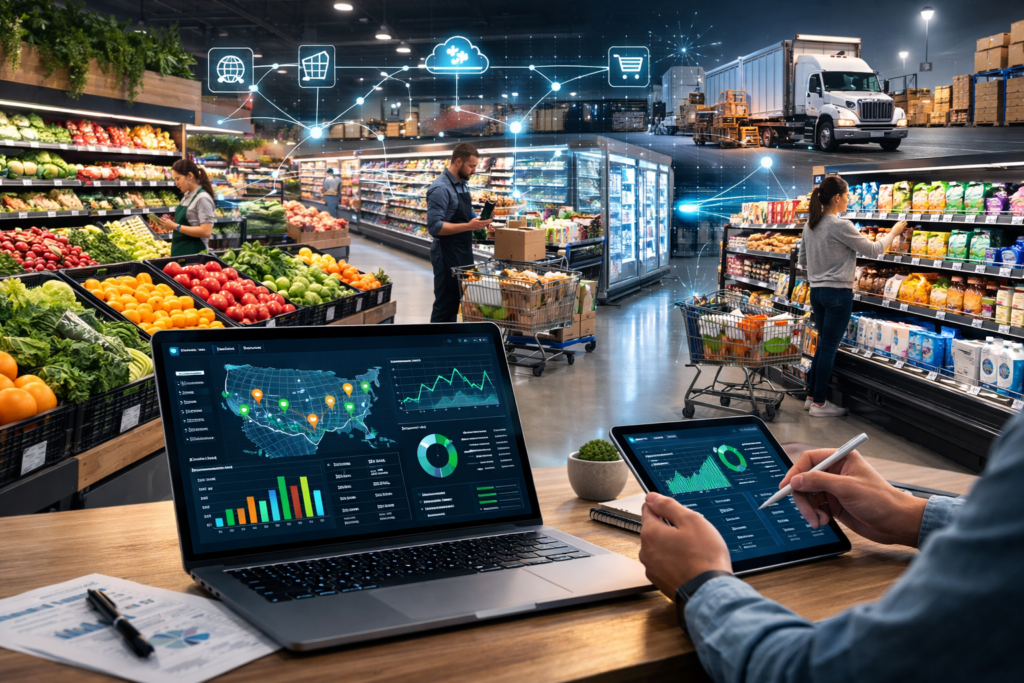
How Afresh Technologies’ AI platform attempts to address the long-standing technology fragmentation inside grocery retail
One of the central operational difficulties facing supermarket operators is the lack of coordination between store-level activities and supply chain decisions made at corporate headquarters or distribution centers. A promotional campaign launched by a merchandising team may change demand patterns for a specific product across hundreds of stores, yet traditional systems often require separate manual updates to store ordering processes, distribution center procurement plans, and production schedules.
Afresh Technologies’ platform attempts to solve this coordination problem by operating as a unified decision system that integrates demand forecasting, replenishment recommendations, and purchasing planning across the entire supply chain. The system relies on a single artificial intelligence engine but applies different data models and operational rules depending on the department in which it is operating.
A cereal aisle, for instance, generally relies on stable product identifiers, standardized case packs, and predictable promotional cycles. In contrast, a butcher counter must account for random-weight products, in-store cutting operations, and daily fluctuations in consumer demand. Bakery and prepared food departments add further complexity by combining inventory management with production planning that determines how much food must be prepared during specific time windows throughout the day.
Afresh Technologies’ platform incorporates these variations into department-specific workflows that translate store data into ordering recommendations and production guidance. According to the company, store teams follow the system’s recommendations at adherence rates exceeding ninety-five percent across different product types. That level of adoption suggests that the platform has achieved operational credibility among store employees who traditionally relied heavily on manual judgment and experience when managing inventory.
Could the expansion of AI-driven grocery platforms reshape how supermarkets manage profitability and food waste
The grocery industry operates on extremely narrow profit margins, often measuring operating income in low single digits. In such an environment, small inefficiencies in inventory planning can have significant financial consequences. Overstocking ties up working capital and increases the risk of spoilage, while stockouts lead to lost sales and frustrated customers who may switch retailers.
Food waste represents one of the most visible outcomes of these inefficiencies. Fresh produce, dairy products, meat, and prepared foods frequently expire before they are sold, creating both environmental and economic costs across the supply chain.
Afresh Technologies reports that its platform has already helped retailers prevent more than 200 million pounds of food waste since the company was founded in 2017. The expansion of the platform to additional store departments could increase that impact by enabling retailers to coordinate inventory decisions across both perishable and non-perishable categories.
The broader implication is that artificial intelligence may allow supermarkets to approach inventory management with a level of precision that was previously difficult to achieve. By combining demand forecasting with real-time operational data from stores and distribution centers, AI systems can adjust ordering patterns more dynamically than traditional rule-based inventory tools.
What operational advantages unified AI grocery systems could provide for retailers managing complex store environments
The most immediate benefit of a unified grocery technology platform lies in improved coordination between departments and supply chain layers. When replenishment planning, inventory management, and purchasing decisions are managed through separate systems, retailers often struggle to ensure that each part of the organization is responding to the same information.
Afresh Technologies’ system attempts to eliminate those silos by ensuring that promotional decisions made at the corporate level automatically cascade through the rest of the organization. If a retailer launches a two-week promotion for a product such as steak or milk, the platform can automatically adjust store replenishment recommendations, update distribution center purchasing volumes, and align in-store production planning without requiring manual coordination between departments.
Another practical advantage lies in deployment speed. Enterprise technology systems for grocery retailers have historically required lengthy implementation projects that can extend well beyond a year and involve significant consulting resources. Afresh Technologies indicates that its platform can typically be deployed in less than four months, which could lower the barrier to adoption for retailers seeking faster modernization of their technology infrastructure.
For retailers already using Afresh Technologies’ software in fresh departments, the expansion into center-store categories can also be implemented incrementally without requiring a complete replacement of existing enterprise systems. That modular approach allows retailers to adopt artificial intelligence capabilities while preserving legacy platforms that remain operationally necessary.
How Afresh Technologies fits into the broader race to modernize grocery retail infrastructure with artificial intelligence
The grocery sector has historically lagged behind other retail categories in the adoption of advanced analytics and artificial intelligence tools. The operational complexity of managing perishables, decentralized store operations, and thousands of product variations has made it difficult for traditional enterprise software vendors to develop systems that fully address supermarket workflows.
Afresh Technologies has attempted to differentiate itself by building a platform specifically designed around grocery operations rather than adapting general retail software to the sector’s unique requirements. This strategy has attracted partnerships with several major grocery retailers, including Albertsons Companies, Meijer, Wakefern, Stater Bros., and Brookshire Brothers.
The company states that its platform currently supports operations across more than 12,000 grocery departments in forty U.S. states, providing a meaningful base from which to expand its technology footprint. While the company remains a relatively young player in enterprise retail software, its focus on grocery-specific workflows may allow it to compete effectively with larger technology providers that historically approached the sector from a packaged goods perspective.
More broadly, the expansion reflects a structural change taking place across retail and supply chain industries. Businesses that once relied on fragmented operational systems are increasingly adopting unified AI-driven platforms capable of integrating data from multiple parts of the organization. Grocery retail may simply represent the next frontier in that transition.
Key takeaways: What Afresh Technologies’ expansion signals for grocery retailers and supply chain technology
- Afresh Technologies has expanded its AI platform beyond fresh departments to manage inventory and replenishment decisions across the entire supermarket.
- The platform now integrates demand forecasting, store ordering, and distribution center purchasing within a single AI system.
- Grocery retailers have historically relied on fragmented technology tools that struggle to coordinate decisions across departments.
- Afresh Technologies’ approach begins with fresh food complexity and extends intelligence to packaged goods and general merchandise.
- The platform has already placed more than 320 million orders annually for shelf-stable products.
- Retailers using the system report adherence rates above ninety-five percent for automated ordering recommendations.
- The technology has helped prevent more than 200 million pounds of food waste since the company’s founding in 2017.
- Faster deployment timelines compared with traditional enterprise systems could accelerate adoption among supermarket chains.
- Partnerships with retailers such as Albertsons Companies and Meijer provide early validation of the grocery-specific AI model.
- The expansion reflects a broader industry shift toward unified artificial intelligence platforms that coordinate retail supply chains end-to-end.
Discover more from Business-News-Today.com
Subscribe to get the latest posts sent to your email.