




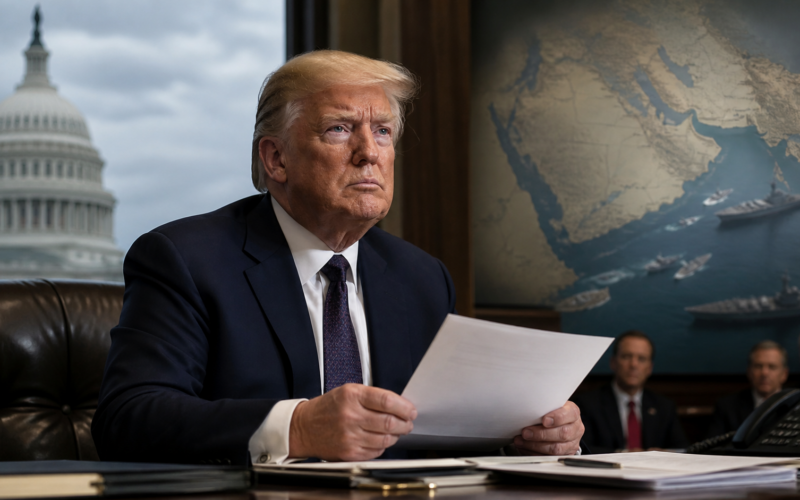
The United States House of Representatives has passed a war powers resolution aimed at ending President Donald Trump’s military campaign against Iran unless Congress formally authorises the conflict, delivering a rare bipartisan rebuke to the White House and sharpening a constitutional fight over who controls the power to take the United States into war.
The House voted 215 to 208 in favour of the Democratic-led measure, with four Republican lawmakers joining Democrats to support the resolution. The vote directs President Donald Trump to withdraw United States forces from hostilities involving Iran unless Congress declares war or authorises military force. The measure still faces uncertainty in the United States Senate and does not by itself end the conflict, but the vote is politically significant because it passed in a Republican-controlled House.
The resolution comes nearly three months after the United States and Israel launched strikes against Iran, triggering a wider conflict that has drawn the United States military deeper into the Middle East. Supporters of the war powers measure argue that President Donald Trump has sustained military action without clear congressional authorisation, while the Trump administration has argued that the president has acted within his constitutional authority as commander in chief.
The vote also reflects growing unease among some Republican lawmakers over the duration, cost and strategic clarity of the Iran conflict. Earlier attempts to curb President Donald Trump’s Iran war powers had failed or been postponed, but the latest House vote showed that congressional resistance has gained enough support to overcome Republican leadership’s control of the chamber.
Why did the United States House vote to restrict Donald Trump’s Iran war powers?
The United States House voted to restrict President Donald Trump’s Iran war powers because a majority of lawmakers backed the argument that Congress must authorise sustained military hostilities. The resolution is rooted in the constitutional division of war powers, where the president commands the armed forces but Congress holds the authority to declare war and approve prolonged military engagement.
The Democratic-led measure passed 215 to 208, with four Republicans joining Democrats. That margin matters because Republicans control the House, and the vote therefore cannot be dismissed as a purely partisan Democratic protest. It indicates that concerns about the Iran conflict have reached at least part of President Donald Trump’s own party.
The resolution directs President Donald Trump to withdraw United States troops from hostilities involving Iran unless Congress declares war or passes a formal authorisation for military force. Supporters argue that the United States should not remain in a Middle East conflict through executive action alone, particularly after months of military engagement and regional escalation.
The broader consequence is a renewed confrontation over the balance of power between Congress and the White House. War powers debates are not new in Washington, but they become more politically charged when United States forces are already engaged and when lawmakers believe the executive branch has not presented a clear end state.
How does the Iran war powers vote challenge the Trump administration’s Middle East strategy?
The vote challenges the Trump administration’s Middle East strategy by questioning whether the president has sufficient legal and political backing to continue military operations against Iran. The Trump administration has framed the campaign as necessary for United States security, Israeli security and pressure on Iran’s nuclear and regional military networks. The House vote signals that Congress is no longer willing to let that argument go untested.
President Donald Trump has argued that his approach will produce a better outcome with Iran, while critics say the administration has escalated into a prolonged conflict without setting out a credible path to termination. That disagreement is not merely rhetorical. It affects troop deployment, diplomatic leverage, defence spending and relations with United States allies in the region.
Secretary of State Marco Rubio has warned that efforts to restrict the administration’s military flexibility could complicate negotiations with Iran. The administration’s argument is that military pressure and diplomacy are linked, and that weakening the president’s hand could reduce United States leverage in talks involving Iran’s nuclear programme, sanctions and the Strait of Hormuz.
Supporters of the resolution see the issue differently. They argue that Congress should not be asked to accept an open-ended war because the administration says negotiations are ongoing. In their view, if the conflict is important enough to sustain, it is important enough to be debated and authorised by Congress.
Why does bipartisan Republican support make this war powers vote more significant?
The bipartisan nature of the vote makes the resolution more significant because President Donald Trump’s foreign policy decisions usually command strong Republican loyalty in Congress. Four Republican lawmakers breaking with the White House may appear numerically small, but in a closely divided House, that was enough to change the outcome.
The Republican defections show that opposition to the Iran conflict is not limited to Democrats. Some Republicans have long argued that the United States should avoid extended Middle East wars, especially when Congress has not formally authorised the conflict. That strain of Republican scepticism has become more visible as the Iran conflict has continued.
The vote also follows earlier signs of unease in both chambers. A similar war powers effort had advanced procedurally in the Senate, while a previous House vote had failed narrowly. House Republican leaders also delayed an earlier vote after it appeared the measure might pass. The latest result confirms that the political balance has shifted.
For President Donald Trump, the problem is not only the resolution itself. The vote shows that even a small number of Republican lawmakers can disrupt the administration’s war strategy if Democrats remain united. That creates a new pressure point for future votes on defence funding, authorisations, oversight hearings and related Middle East policy decisions.
What role does the United States Constitution play in the Iran war powers dispute?
The United States Constitution is central to the Iran war powers dispute because it divides military authority between the president and Congress. The president serves as commander in chief, but Congress has the power to declare war, raise and support armies, fund military operations and regulate the armed forces.
In practice, modern presidents have often used military force without formal declarations of war. Congress responded to that long-running trend through war powers legislation intended to ensure that lawmakers retain a role when United States forces enter hostilities. The Iran vote is part of that continuing struggle between executive flexibility and legislative control.
Supporters of the resolution argue that President Donald Trump’s Iran campaign has crossed the threshold from limited military action into a sustained conflict requiring congressional authorisation. They argue that the Constitution does not allow a president to maintain an extended war simply because the White House frames the operation as defensive or temporary.
The administration’s position is that the president has authority to protect United States forces, respond to threats and manage military operations in the national interest. That argument has been used by presidents of both parties in past conflicts, but it becomes more contested when hostilities continue for months and when the scale of the conflict widens.
The legal question may not be resolved by this vote alone. However, the political question is already clear. A majority of the House has now stated that Congress should decide whether the Iran conflict continues.
How could the House vote affect the United States Senate and the future of the Iran resolution?
The House vote increases pressure on the United States Senate because it shows that a war powers measure can pass even under Republican control when enough lawmakers break with the president. The Senate has already seen related efforts to restrict President Donald Trump’s Iran war powers, but a final path remains uncertain.
If the Senate takes up the measure, senators will face a difficult political calculation. Supporting the resolution could be framed as defending congressional authority and limiting an unpopular war. Opposing it could be framed as backing the president’s ability to conduct foreign policy during an active crisis.
Senate Republicans are particularly important because the House vote showed that Republican unity is no longer guaranteed. If a small number of Senate Republicans join Democrats, the measure could gain momentum. However, the Senate’s procedural rules, leadership control and broader foreign policy calculations could still slow or block the resolution.
Even if the resolution does not become binding law, the House vote carries political weight. It gives opponents of the Iran conflict a stronger platform for oversight hearings, funding restrictions and public pressure. It also signals to the Trump administration that future Iran-related decisions may face more congressional resistance than earlier actions did.
The vote may also influence negotiations with Iran. Tehran, United States allies and regional governments will all read the congressional move as evidence that domestic support for the conflict is not unlimited. That could affect how different actors judge the durability of President Donald Trump’s policy.
Why does the Iran conflict remain connected to oil markets and the Strait of Hormuz?
The Iran conflict remains connected to oil markets and the Strait of Hormuz because any prolonged United States military confrontation with Iran carries direct consequences for Gulf energy flows. The Strait of Hormuz is one of the world’s most important oil and gas chokepoints, and tensions involving Iran often raise concerns about shipping disruption, insurance costs and energy price volatility.
The Trump administration has treated pressure on Iran as part of a broader security strategy involving Iran’s nuclear programme, regional military networks and threats to maritime stability. Critics in Congress argue that the administration has not clearly explained how military operations will lead to a durable settlement without widening the conflict.
The economic dimension matters for lawmakers because war costs are not limited to defence spending. Military escalation in the Gulf can affect petrol prices, shipping routes, inflation expectations and the cost of imported energy for United States allies. That gives the Iran war powers debate domestic economic relevance as well as foreign policy significance.
President Donald Trump’s supporters may argue that a strong military posture is needed to deter Iran and protect the Strait of Hormuz. Supporters of the House resolution argue that Congress should decide whether that posture justifies sustained hostilities. The disagreement is therefore not only about Iran. It is about how much economic and strategic risk the executive branch can assume without fresh congressional approval.
What does the House vote reveal about United States war fatigue in the Middle East?
The House vote reveals that war fatigue remains a powerful force in United States politics, especially when military action in the Middle East appears open-ended. Lawmakers from both parties are aware that long wars in Iraq and Afghanistan reshaped public tolerance for extended military campaigns without clear outcomes.
The Iran conflict carries that historical baggage. Even supporters of a firm stance against Iran may be cautious about another prolonged regional war. The vote shows that some lawmakers are trying to separate support for United States security from support for indefinite executive military authority.
The political shift is particularly important because President Donald Trump has often presented himself as sceptical of foreign entanglements, even while pursuing hardline policies against Iran. That creates tension within his own coalition. Some Republicans support military pressure against Iran, while others oppose any drift into another Middle East war.
For Democrats, the resolution offers a way to frame opposition around constitutional authority, oversight and public accountability rather than only around disagreement with the administration’s Iran policy. That framing may be more effective because it appeals to institutional concerns as well as anti-war sentiment.
The wider message is that Congress is becoming less willing to defer automatically to the White House on Iran. That does not mean lawmakers have agreed on an alternative strategy. It means the political cost of continuing the war without authorisation is rising.
What happens next after the House vote against Donald Trump’s Iran war powers?
The next steps depend on the Senate, the White House and the administration’s military posture in the Gulf. The House vote alone does not end United States hostilities with Iran. However, it creates a formal congressional marker that opponents of the conflict can use in future legislative and political battles.
If the Senate advances a similar resolution, the pressure on President Donald Trump will increase sharply. A bicameral rebuke would deepen questions about the legal and political foundation of the Iran campaign. If the Senate does not act, the House vote will still remain a warning sign that congressional patience is weakening.
The White House may try to argue that the resolution is unnecessary because diplomacy is continuing or because military operations are limited. The administration may also argue that restricting the president during sensitive negotiations would embolden Iran. Those arguments are likely to remain central to Republican efforts to contain further defections.
Opponents of the conflict will likely keep pressing for hearings, classified briefings and votes tied to funding or authorisation. The Iran war powers debate may therefore continue even if this specific resolution stalls.
The most important outcome is political: the United States House has now shown that President Donald Trump cannot assume automatic congressional backing for the Iran war. That shift may shape every future decision involving military escalation, diplomacy and the role of Congress in the conflict.
What are the key takeaways from the United States House vote on Donald Trump’s Iran war powers?
- The United States House of Representatives voted 215 to 208 to pass a war powers resolution aimed at ending President Donald Trump’s military campaign against Iran unless Congress formally authorises the conflict.
- Four Republican lawmakers joined Democrats in supporting the resolution, making the vote a bipartisan rebuke to President Donald Trump’s Iran policy despite Republican control of the House.
- The resolution directs President Donald Trump to withdraw United States forces from hostilities involving Iran unless Congress declares war or passes an authorisation for military force.
- The vote followed earlier failed or delayed attempts to restrict President Donald Trump’s Iran war powers, showing that congressional resistance has strengthened as the conflict has continued.
- The Trump administration argues that the president has authority as commander in chief, while supporters of the resolution argue that Congress must approve sustained military hostilities.
- The Iran conflict remains connected to wider Middle East risks, including the Strait of Hormuz, oil market stability, sanctions diplomacy and United States military commitments in the Gulf.
- The House vote does not immediately end the Iran conflict, but it increases pressure on the United States Senate and gives lawmakers a stronger basis for oversight and future legislative action.
- The vote shows that war fatigue and concern over executive military authority remain politically powerful in Washington, even among some Republican lawmakers aligned with President Donald Trump.
Discover more from Business-News-Today.com
Subscribe to get the latest posts sent to your email.