



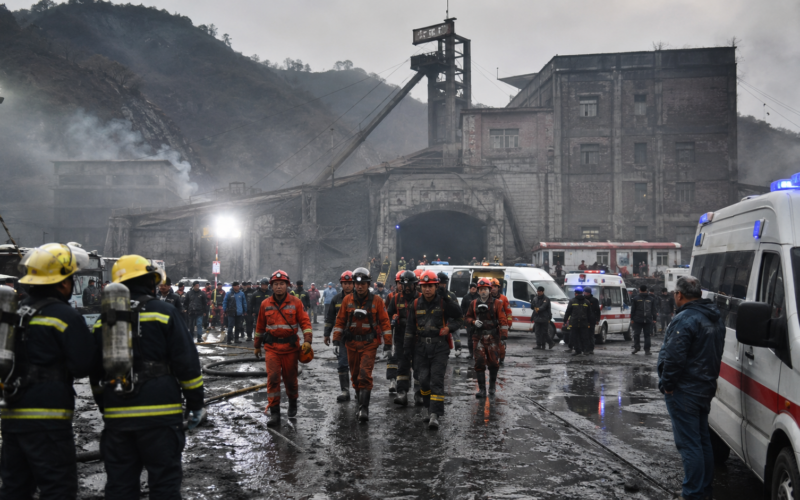
China has confirmed 82 deaths after a gas explosion at the Liushenyu coal mine in Shanxi province, making the accident the country’s deadliest coal mining disaster since 2009 and renewing scrutiny of workplace safety in the world’s largest coal-producing nation.
The explosion occurred at 7:29 p.m. on Friday at the Liushenyu coal mine in Qinyuan county, Changzhi city, while 247 miners were underground. Authorities initially reported 90 deaths, but later revised the confirmed toll to 82 after correcting worker-count confusion in the immediate aftermath of the blast. Two people remained missing, 128 injured workers were taken to hospital, and 35 miners escaped without injury.
The mine is operated by Shanxi Tongzhou Group Liushenyu Coal Industry and controlled by Shanxi Tongzhou Coal Coking Group. Authorities said the company’s four mines had been shut down, company executives had been detained, and investigators were examining the cause of the explosion.
The disaster has drawn high-level attention from China’s leadership. Chinese President Xi Jinping called for exhaustive rescue operations and a thorough investigation, while Chinese Premier Li Qiang called for transparency and accountability. The response reflects the political sensitivity of major industrial accidents in China, where coal remains central to power generation even as Beijing pushes long-term clean-energy expansion.
The Liushenyu coal mine disaster now stands as a severe test of China’s mine-safety system. It also raises difficult questions about production pressure, gas-management standards, ventilation systems, emergency rescue capacity and the enforcement of safety rules in Shanxi, one of China’s most important coal-producing provinces.
Why does the Liushenyu coal mine disaster matter for China’s coal industry and workplace safety system?
The Liushenyu coal mine disaster matters because it combines a high death toll, a strategic coal-producing region and renewed evidence that China’s industrial safety system still faces major enforcement challenges.
Shanxi province is one of China’s most important coal regions, and any major accident in Shanxi immediately carries national importance. Coal remains a backbone of China’s energy system, supplying power plants, heavy industry and winter heating needs. That makes coal mining both economically critical and politically sensitive.
The confirmed death toll of 82 makes the Liushenyu coal mine explosion China’s deadliest coal mining accident since the 2009 Xinxing mine disaster in Heilongjiang province, which killed 108 people. That comparison matters because China has spent years tightening safety regulations, consolidating mines, shutting smaller unsafe operations and improving monitoring systems.
The broader consequence is that the Liushenyu coal mine disaster will test whether those reforms have changed outcomes in practice. A single catastrophic explosion can expose weaknesses in gas detection, ventilation, underground mapping, rescue planning and regulatory supervision. For China’s national authorities, the issue is not only what went wrong at Liushenyu, but whether similar risks exist across other mines.
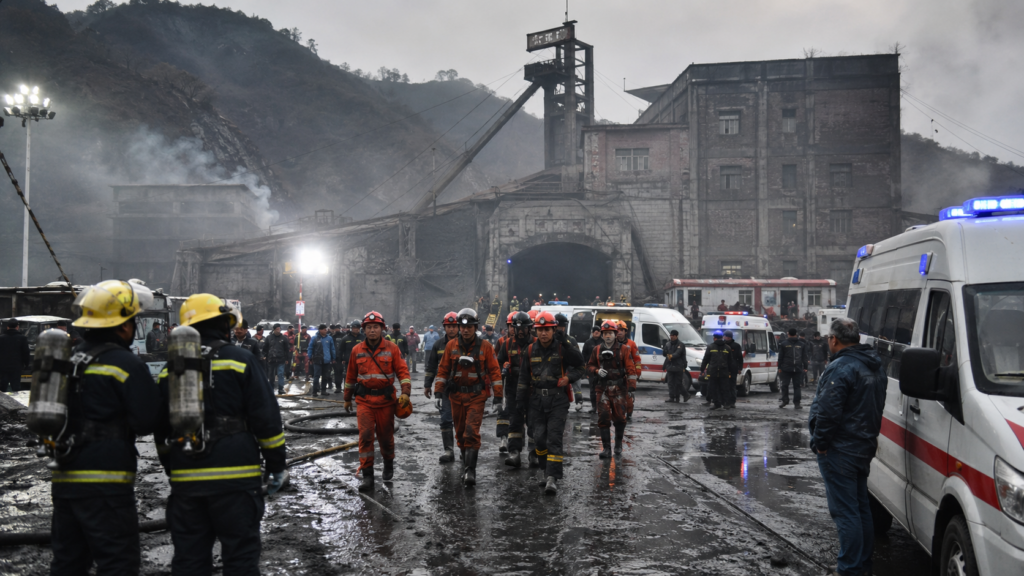
What happened at the Liushenyu coal mine in Qinyuan county, Shanxi province?
The Liushenyu coal mine explosion occurred on Friday evening while 247 workers were underground at the site in Qinyuan county, Changzhi city, Shanxi province.
The blast was reported as a gas explosion. Emergency personnel, medical teams and local authorities were deployed to rescue trapped workers, treat injured miners and identify the missing. The early death toll was reported at 90, but authorities later revised the confirmed number to 82 after correcting confusion in worker counts during the chaotic response.
The revised casualty picture remains severe. Two miners were still missing, 128 injured workers were hospitalised, and 35 miners escaped without injury. The scale of injuries shows that the explosion affected a large portion of workers underground at the time.
The operational details are important because rescue work in underground coal mines is technically difficult. Gas, smoke, damaged tunnels, unstable structures and inaccurate underground layouts can all slow emergency response. Associated Press reporting said local officials identified serious legal violations at the mine, including discrepancies between the reported and actual mine layout, which complicated rescue operations.
Who operates the Liushenyu coal mine and what action have Chinese authorities taken?
The Liushenyu coal mine is operated by Shanxi Tongzhou Group Liushenyu Coal Industry, which is controlled by Shanxi Tongzhou Coal Coking Group.
After the explosion, authorities shut down the company’s four mines and detained executives connected to the operation. Officials also began investigating the cause of the blast and whether safety violations contributed to the disaster. The closures signal that the response is not limited to one accident site, but extends to the operator’s wider mining portfolio.
The institutional response reflects how China handles major industrial disasters. Local and provincial authorities typically move quickly to secure the site, detain responsible personnel, suspend related operations and establish investigation teams. These steps are meant to preserve evidence, prevent further accidents and show that accountability will follow.
The broader consequence for Shanxi Tongzhou Coal Coking Group is serious. Mine shutdowns can affect production, revenue, licensing status and future regulatory treatment. For China’s coal sector, the operator-level response sends a warning that major accidents can trigger immediate enforcement action across related assets.
Why is Shanxi province central to China’s coal production and energy security?
Shanxi province is central to China’s coal production because it is one of the country’s largest coal-producing regions and a pillar of national energy supply.
China remains the world’s largest coal producer and consumer. Coal continues to support power generation, steelmaking, chemicals and industrial activity despite China’s massive expansion of renewable energy. Shanxi’s coal output therefore has direct relevance for electricity reliability, industrial supply chains and national energy planning.
A major disaster in Shanxi creates a difficult policy balance. Authorities must investigate safety failures and suspend unsafe operations, but China also needs steady coal supply to support its economy. That tension has shaped coal policy for years: Beijing has tried to improve mine safety and reduce excess capacity while also avoiding shortages that could disrupt power supply.
The Liushenyu disaster may lead to more inspections across Shanxi and other coal regions. If inspections find widespread violations, temporary production disruptions could follow. If inspections are narrow or short-lived, safety advocates may question whether enforcement is strong enough to prevent another disaster.
What does the revised death toll reveal about the early response to the Shanxi mine explosion?
The revised death toll reveals how difficult it can be to establish accurate casualty figures after a large underground mining disaster.
Authorities initially reported that at least 90 people had died. The confirmed toll was later lowered to 82 after officials corrected worker-count confusion. Such revisions can occur when underground attendance records, shift logs, rescue lists and hospital records do not immediately align.
The correction does not reduce the severity of the disaster. Eighty-two confirmed deaths still make the Liushenyu coal mine explosion China’s deadliest coal mining accident in 17 years. The continued search for two missing workers also means the final casualty picture may require further confirmation.
The institutional implication is important. Accurate worker tracking is a core safety function in underground mining. Regulators need to know who entered the mine, where workers were deployed, who escaped, who was hospitalised and who remains trapped. Confusion in worker counts can slow rescue operations and weaken public trust during a crisis.
How does the Liushenyu disaster compare with China’s past coal mining accidents?
The Liushenyu disaster is China’s worst coal mining accident since the 2009 Xinxing mine explosion in Heilongjiang province, where 108 people died.
China’s coal industry has a long history of deadly accidents, particularly involving gas explosions, flooding, collapses and ventilation failures. In earlier decades, large disasters killed hundreds of miners, including the 1960 Laobaidong coal mine methane explosion in Shanxi province, one of the deadliest mining accidents in China’s history.
The comparison with past disasters is important because China has made measurable improvements in mine safety over time. Stricter regulation, consolidation of smaller mines, better monitoring and stronger enforcement helped reduce annual deaths compared with the worst years of the 1990s and early 2000s. Yet the Liushenyu explosion shows that catastrophic failure remains possible.
For Chinese regulators, the historical lesson is clear: safety gains can be reversed if enforcement weakens, production pressure rises or operators conceal risks. The latest disaster may therefore become a reference point in future campaigns on coal mine supervision and industrial accountability.
Why are gas explosions such a recurring risk in underground coal mining?
Gas explosions are a recurring risk in underground coal mining because methane and other combustible gases can accumulate in enclosed spaces if ventilation, monitoring and drainage systems fail.
In coal mines, methane can be released from coal seams during extraction. If methane concentrations rise and an ignition source is present, an explosion can occur. Carbon monoxide and smoke can then spread through tunnels, causing suffocation risks even for miners not directly hit by the blast.
That is why modern coal mine safety depends heavily on ventilation, gas drainage, continuous monitoring, sensor alarms, emergency shutdown systems and accurate underground maps. If any of these systems are missing, disabled, poorly maintained or ignored, the risk increases sharply.
The Liushenyu disaster has therefore shifted attention to whether gas levels were properly managed before the explosion. Guardian reporting cited accounts that a carbon monoxide sensor alarm preceded the blast and noted that the mine had previously been flagged for severe safety risks linked to high gas levels. Those details will be central to the official investigation if confirmed by Chinese authorities.
What are the political stakes for Chinese President Xi Jinping after the Shanxi mine explosion?
The political stakes are significant because major workplace disasters in China raise questions about local governance, regulatory enforcement and whether economic development has been prioritised over safety.
Chinese President Xi Jinping called for exhaustive rescue efforts and a thorough investigation. Chinese Premier Li Qiang called for transparency and accountability. These statements signal that the central government views the disaster as a national safety issue, not only a local industrial accident.
The political challenge is that China’s governance system places heavy responsibility on local officials to enforce national standards. If a mine operates with serious violations, questions naturally follow about local inspections, licensing, reporting and whether warnings were ignored. In high-casualty incidents, accountability often extends beyond company executives to regulators and local officials.
The broader consequence is that the Liushenyu disaster may trigger another national safety campaign. China has used such campaigns after major accidents to inspect hazardous sectors, punish violations and reinforce central government priorities. The effectiveness of any campaign will depend on whether enforcement is sustained after public attention fades.
What are the key takeaways from the Liushenyu coal mine disaster in Shanxi province?
- China confirmed 82 deaths after a gas explosion at the Liushenyu coal mine in Qinyuan county, Shanxi province.
The initial death toll of 90 was later revised after authorities corrected worker-count confusion following the blast. - The explosion occurred at 7:29 p.m. on Friday while 247 miners were underground.
Two people remained missing, 128 injured workers were hospitalised, and 35 miners escaped without injury. - The Liushenyu coal mine is operated by Shanxi Tongzhou Group Liushenyu Coal Industry.
Authorities shut down four mines connected to the company and detained executives after the disaster. - The accident is China’s deadliest coal mining disaster since the 2009 Xinxing mine explosion in Heilongjiang province.
The 2009 disaster killed 108 people and had long stood as the benchmark for China’s worst recent coal mine tragedy. - Chinese President Xi Jinping called for exhaustive rescue work and a thorough investigation.
Chinese Premier Li Qiang called for transparency and accountability as authorities examined the cause of the explosion. - The disaster has renewed scrutiny of gas management, mine ventilation, worker tracking and safety enforcement in China’s coal sector.
Shanxi province’s role as a major coal-producing region makes the accident nationally significant for energy security and industrial safety.
Discover more from Business-News-Today.com
Subscribe to get the latest posts sent to your email.